Cambridge IELTS 21 | Complete Guide With Video Tutorials & Answers
June 29th: I have received the book. I will be using Cambridge IELTS 21 in all my private lessons.
June 24th: Speaking Module has been added.
June 5th: Cambridge IELTS 21 books and digital bundles have been added to the official Cambridge book store and you can preorder them here. Keep in mind that I will not be able to share copyrighted material. However, I will be able to use the new tests as a reference to create similar practice tests here.
Comments are enabled on this page. You can share your responses, ask questions, and express your views.
This page is a work in progress. It will be regularly updated over the next few weeks.
Table of Contents
Cambridge IELTS 21 Listening Module
As usual, Cambridge has released a free sample from the upcoming Cambridge IELTS 21, set to publish in July 2026. You can download the official free sample from here. Cambridge doesn’t provide the audio for these free samples, but I’ve created an unofficial recording that matches the answers from their sample. Using the preparation time properly to narrow down the possible answers is key. This is a skill I work on with many of my students, while exploring the sample questions in detail.
Listening Test 1, Part 1, Questions 1-6
Instructions:
Write ONE WORD AND/OR A NUMBER for each answer.
| Name of course | What you learn | Cost | Other information |
|---|---|---|---|
| Taster day | Introduction to sailing | £120 if booking one place | Small groups (max 1 people) |
| Level 1 |
|
£200 |
|
Answers & Explanation
1. Any natural number or written form (if it’s only one word)
Possible answers:
1 / 2 / 3 / 4 / 5 / 6 / 7 / 8 / 9 / 10 / 11
one / two / three / four / five / six / seven / eight / nine / ten / eleven
2. Waves
Other possible answers: currents / wind / moon
3. Weather
Other possible answers: climate
4. Meals
Other possible answers: food / lunch / dinner / refreshments
5. Brochure
Other possible answers: leaflet / guide / booklet / handbook
6. Certificate
Other possible answers: ceremony / party / trophy
1. Numbers
In “max 1 ___ people,” the blank is expressing quantity. Grammatically, it functions as a numerical modifier of the noun “people,” so the slot must be filled by a number or number word. This allows both digits (1, 2, 3…) and written forms (one, two, three…). IELTS Listening frequently accepts both without distinction. The structure excludes multi-word expressions, so the response must remain a single lexical item representing quantity.
2. Waves / Currents / Wind / Moon
In “understanding the ___ and tides,” the blank forms part of a coordinated noun phrase linked by “and,” which requires a noun. The context is maritime, so the word must belong to the semantic field of ocean or sailing conditions. waves is the most conventional collocation with “tides,” while currents is also acceptable as a related hydrological term. Wind is relevant to sailing conditions, and moon is scientifically connected to tidal movement. The key requirement is that the item must be a noun that fits naturally within the domain of tidal phenomena.
3. Weather / Climate
In “including ___ information,” the blank modifies the noun “information,” forming a compound structure. Since “information” is uncountable, the preceding element must function as a noun used attributively. Weather is the most context-appropriate choice, referring to immediate environmental conditions relevant to sailing. Climate is also grammatically valid but refers to longer-term patterns, making it less specific to operational sailing decisions. The distinction is primarily contextual rather than grammatical.
4. Meals / food / lunch / dinner / refreshments
In “___ available for club members,” the verb “available” requires a noun that denotes something provided or accessible. The structure excludes verbs and adjectives, and the response must be a single noun. meals fits naturally in the context of a sailing club offering provisions. Alternatives such as food, lunch, dinner, and refreshments are also grammatically acceptable as they function as countable or mass nouns describing provisions.
5. Brochure / leaflet / guide / booklet / handbook
In “a useful ___,” the indefinite article “a” requires a singular countable noun beginning with a consonant sound. This eliminates plural forms and non-nominal categories. brochure is the most standard answer in course-related contexts, referring to an informational document. Other acceptable nouns include leaflet, guide, booklet, and handbook, all of which fit the same grammatical and semantic category. The structure is strongly constrained by article–noun agreement. This can help you a lot in narrowing down your options.
6. Certificate / Ceremony / Party / Trophy
For “a ___ at the end of the course,” students should mentally fast-forward to the end of a training programme. When people finish a course, there is usually some form of recognition or closure. In formal learning environments, the most expected outcome is a certificate confirming completion. However, depending on the setting, there might also be a small ceremony, a social party, or even a symbolic trophy if it is competitive. The key reasoning step is to think: “What normally happens when a course ends?” and choose the most standard institutional outcome rather than the most imaginative one. Keep in mind that this word cannot start with the letter A, I, E, O, or U.
Listening Test 1, Part 1, Questions 7-10
| General Information |
|---|
|
Answers & Explanation
7. towel / cap / goggles / sunscreen
8. gym / store / shop / café / cafe / bar
9. courses / programmes / programs / apps / modules / videos
10. discounts / boats / lessons / instructors / vouchers
7. towel / cap / goggles / sunscreen
In “Bring suitable clothing, a ___ and toiletries,” the key step is noticing that the sentence is dividing items into categories. “Clothing” is already one category, and “toiletries” is a separate one, so the missing item probably belongs to neither group. That immediately rules out anything that would normally be classified as clothing or hygiene products like soap or shampoo. Instead, the blank is likely to be something used alongside clothing in a practical outdoor or water-based activity. This is why items such as a towel, cap, goggles, or sunscreen fit naturally: they are not clothing themselves, but they are commonly needed in the same context. The reasoning comes from separating functional categories in the sentence rather than searching for vocabulary in isolation.
8. gym / store / shop / café / cafe / bar
In “There is a ___ at the club,” the grammar provides a strong clue. The article “a” shows that the answer must be a singular countable noun beginning with a consonant sound. This immediately helps eliminate anything that would require “an” or anything that does not function as a noun. From a context perspective, students should think about what facilities are typically found in a sports or sailing club. A gym is common in many clubs, as are a store or shop for equipment. A café or bar also fits because clubs often include social or refreshment areas. The key approach is combining grammatical constraint with real-world expectations of club facilities.
9. courses / programmes / programs / apps / modules / videos
In “Online training ___ are recommended,” the plural form indicates that the blank refers to multiple units or resources related to training. Students should first identify that “online training” implies digital learning, so the answer must be something that can exist in an online format. In real-world learning environments, this could be structured as courses or programmes, or broken down into modules, or delivered through apps or videos. The key reasoning step is to think about how training is actually accessed online rather than relying on a single fixed vocabulary set. The plural verb form helps confirm that the answer must also be plural.
10. discounts / boats / lessons / instructors / vouchers
In “___ are available for course participants,” the plural verb “are” signals that the answer must be a plural noun. The task is to imagine what a participant might realistically receive as part of or after enrolling in a course. In practical terms, organizations often provide discounts or vouchers as incentives for future bookings. In a sailing context, access to boats or additional lessons is also realistic, as well as support from instructors. The reasoning here relies on thinking about added value or benefits offered to participants rather than focusing only on vocabulary patterns. The plural structure confirms that the answer must represent multiple items or a collective benefit.
Cambridge IELTS 20 Authentic Reading Practice
IELTS Reading Practice Tests [With Quizzes & Answers]
The IELTS Academic Reading section contains three academic passages and 40 questions to be completed in 60 minutes. It includes a range of question types such as multiple choice, matching headings, matching information, matching features, sentence completion, summary completion, short-answer questions, and True/False/Not Given. The section is designed to assess your understanding of main ideas, specific details, inferences, and the writer’s opinion or attitude.
The practice tests below are based on real exams from Cambridge IELTS 18, Cambridge IELTS 19, and Cambridge IELTS 20. Each one closely follows the original format, using authentic reading passages and official question types.
All tests are available as interactive quizzes with instant feedback and complete answer keys. These are meant to provide realistic practice and help you get used to the structure, timing, and difficulty level of the actual IELTS Reading section.
Cambridge IELTS 21 Speaking Module
Disclaimer: To respect copyright laws, I can’t share the exact IELTS Speaking questions. Instead, I’ve rewritten them while keeping the original topics and ideas intact. The structure and focus are essentially the same.
These questions are based on the four speaking tests found in the Cambridge IELTS 20 Academic book. Fortunately, Cambridge can’t copyright broad topics like food or college life, though I’m sure their legal team wishes they could. They seem pretty intent on limiting students’ access to real test-prep material. By practicing with these reworded questions, you’ll still get realistic preparation without running into any copyright issues. If you can respond well to these, you’ll be in good shape for the real test.
Tests 1 to 4 are recreated to match the original tests as closely as legally allowed. Tests 5 to 8 are new tests I created based on the book’s tone, difficulty, and question style.
IELTS 21 Speaking: Test 1
Part 1
- How often do you follow a skincare or grooming routine?
- Have you recently changed any of your personal care habits?
- Would you ever try a cosmetic treatment to change your appearance?
- Do you enjoy shopping for personal care products?
Part 2
Describe a time when you used a map or navigation tool to find your way somewhere.
– what tool or resource you used
– where you were trying to go
– what information it provided
Explain whether it made your journey easier or more difficult.
Part 3
A: Travel Styles
– What types of travel experiences are most popular among people in your country?
– Do most people in your country prefer travelling domestically or internationally?
– Why do some people prefer a completely relaxing trip with no activities planned?
B: Local Landmarks
– What kinds of places do foreign visitors most enjoy seeing in your country?
– Should entry to national monuments or cultural sites be free for residents?
– What factors can make a well-known landmark disappointing to visit?
IELTS 21 Speaking: Test 2
Part 1
- How familiar are you with the town or village where you grew up?
- Do you think smaller towns are better places to live than cities?
- Why do some people find rural life unappealing?
- If you could live anywhere in the world, what kind of place would you choose?
Part 2
Describe a time when someone gave you information that turned out to be wrong or misleading.
– who gave you this information
– what the information was about
– how you discovered it was incorrect
Explain how this experience affected your trust in that person or source.
Part 3
A: Trust and Children
– Do you think children trust people more easily than adults do?
– Why do parents and teachers emphasise the importance of honesty to children?
– Are there situations where it might be acceptable for adults to withhold the truth from children?
B: Trust and the Media
– Do you think news outlets sometimes report things that are inaccurate?
– Why do people continue to follow certain media sources even when those sources have been unreliable?
– Should there be stronger regulations for media organisations that consistently report false information?
IELTS 21 Speaking: Test 3
Part 1
- Do you prefer paying for things in cash or digitally when you shop?
- Do you tend to think carefully before making a purchase?
- Can you recall a time you bought something that turned out to be unnecessary?
- How much of a priority is building your savings for the future?
Part 2
Describe a public space such as a square, waterfront, or outdoor area that you found particularly memorable.
– where this place is located
– how large the space is
– what features or activities you noticed there
Explain what made this place stand out to you.
Part 3
A: Urban Living Spaces
– What are the benefits of having access to outdoor space when you live in a city?
– How might people in high-rise buildings incorporate greenery into their living environment?
– How popular are home improvement and interior design programmes in your country?
B: Nature as a Hobby
– Do you think spending time in nature appeals more to certain age groups?
– In what ways can regularly engaging with nature benefit a person’s wellbeing?
– Do you think more people will seek out nature-based hobbies in the coming years?
IELTS 21 Speaking: Test 4
Part 1
- At what times of day do you usually eat snacks or street food?
- How central is street food or traditional snacking to your culture?
- Have you tried any snacks or street foods from other countries?
- Would you be interested in learning to prepare a traditional snack from scratch?
Part 2
Describe a person you know who is very ambitious.
– who this person is
– what they are ambitious about
– how much progress they have made toward their goals
Explain what you think drives their ambition.
Part 3
A: Achievement and Recognition
– What kinds of achievements do people in your country tend to celebrate most?
– What do you think makes a reward or form of recognition truly meaningful?
– Why are talent-based programmes and achievement shows so widely watched?
B: Ambition in the Workplace
– How important is ambition as a quality in a professional environment?
– Do you think people perform better professionally when they work alongside highly driven colleagues?
– Why do some people believe that enjoying your work matters more than advancing your career?
IELTS 21 Speaking: Test 5
Part 1
- How many hours of sleep do you usually get each night?
- Do you have a regular bedtime routine?
- Has your sleep pattern changed at any point in your life?
- How does a poor night’s sleep affect you the following day?
Part 2
Describe a time when you had to wait much longer than expected for something.
– what you were waiting for
– why the wait was longer than expected
– what you did during this time
Explain how you felt about the experience of waiting.
Part 3
A: Patience in Daily Life
– Do you think people today are less patient than previous generations?
– In what situations do you think it is most difficult for people to be patient?
– How can parents encourage children to develop patience?
B: Waiting and Modern Society
– How has technology changed the way people feel about waiting for things?
– Do you think same-day delivery and instant services are making people less tolerant of delays?
– Should businesses do more to compensate customers when they are kept waiting?
IELTS 21 Speaking: Test 6
Part 1
- Do you follow fashion trends when choosing what to wear?
- Has your taste in clothing changed over the years?
- Do you prefer buying clothes in shops or online?
- How important is it to you to dress appropriately for different occasions?
Part 2
Describe a skill you learned outside of school or any formal education setting.
– what the skill is
– how and where you learned it
– how long it took you to feel confident in it
Explain how useful or important this skill has been in your life.
Part 3
A: Informal Learning
– What are the advantages of learning a skill informally compared to taking a class?
– Do you think self-taught skills are valued as much as formally acquired ones by employers?
– How has the internet changed the way people learn new skills outside of education?
B: Practical Skills in Society
– Which practical life skills do you think young people most need to learn today?
– Should schools dedicate more time to teaching everyday practical skills?
– Do you think older generations have practical skills that younger people are losing?
IELTS 21 Speaking: Test 7
Part 1
- What time do you usually wake up on a weekday?
- Do you consider yourself a morning person or an evening person?
- Has your daily routine changed significantly in recent years?
- How important is it to you to start the day in a particular way?
Part 2
Describe an occasion when you helped a stranger.
– where and when this happened
– what the situation was
– what you did to help
Explain how you felt about helping this person.
Part 3
A: Helping Others in the Community
– Do you think people in cities are less likely to help strangers than people in smaller towns?
– What motivates some people to regularly help others without expecting anything in return?
– How can communities encourage a stronger culture of mutual support?
B: Volunteering
– How popular is volunteering among young people in your country?
– What do you think individuals personally gain from volunteering?
– Do you think governments should do more to promote and support volunteering programmes?
IELTS 21 Speaking: Test 8
Part 1
- How many languages do you speak?
- At what age do you think it is easiest to learn a new language?
- Have you ever tried to learn a language and given up?
- Do you think being bilingual gives people an advantage in life?
Part 2
Describe a piece of technology that you found difficult to use when you first encountered it.
– what this technology was
– when and why you needed to use it
– what made it difficult to learn
Explain how you eventually became comfortable using it.
Part 3
A: Technology and Older Generations
– Why do some older people find it difficult to adapt to new technology?
– What can younger family members do to help older relatives use technology more confidently?
– Do you think society moves too fast when adopting new technology without considering those who struggle to keep up?
B: Technology in Education
– How has technology changed the way students learn in your country?
– Do you think children are spending too much time on screens in educational settings?
– Will traditional classrooms eventually be replaced by fully digital learning environments?
Cambridge IELTS 21 Speaking Module Sample Answers
I’m currently working on preparing the sample answers for the Cambridge IELTS 21 Speaking Module. In the meantime, click here to access detailed sample answers, scoring criteria, and thorough explanations for every part of the IELTS Speaking section from Cambridge IELTS 19. This page covers all the questions from 4 tests in book 19 and offers both high-level and mid-to-low-level spoken responses with audio. Transcripts are also provided to help you follow along and improve your speaking skills effectively.
Cambridge IELTS 21 Writing Module
Disclaimer: For the writing section, just like in the speaking section above, I’ve created original questions that reflect the style and structure of the official prompts, giving you realistic, high-quality practice while avoiding any copyright issues. The core ideas remain intact to help you build real exam skills. You can use the form below to submit your writing. If you’d like professional feedback, including estimated scores or a real-time video review, you can place an order here.
I’m currently working on preparing the sample answers for the Cambridge IELTS 21 Speaking Module. Click here to access high-level and mid-level sample responses for both Writing Task 1 and Task 2 from Cambridge IELTS 20. Each sample is accompanied by detailed examiner notes that assess the writing according to official IELTS scoring criteria, covering task achievement or task response, coherence and cohesion, lexical resource, and grammatical range and accuracy. The complete guide to Cambridge IELTS 19 Writing is also available here.
These notes highlight strengths and weaknesses to help you understand what examiners look for and how to improve your own writing. For more on the scoring system, you can refer to the official IELTS Writing Band Descriptors and IELTS Writing Key Assessment Criteria provided by IELTS.
Cambridge IELTS 21 Academic Writing Module (Task 1)
IELTS 21 Academic Writing Task 1: Test 1
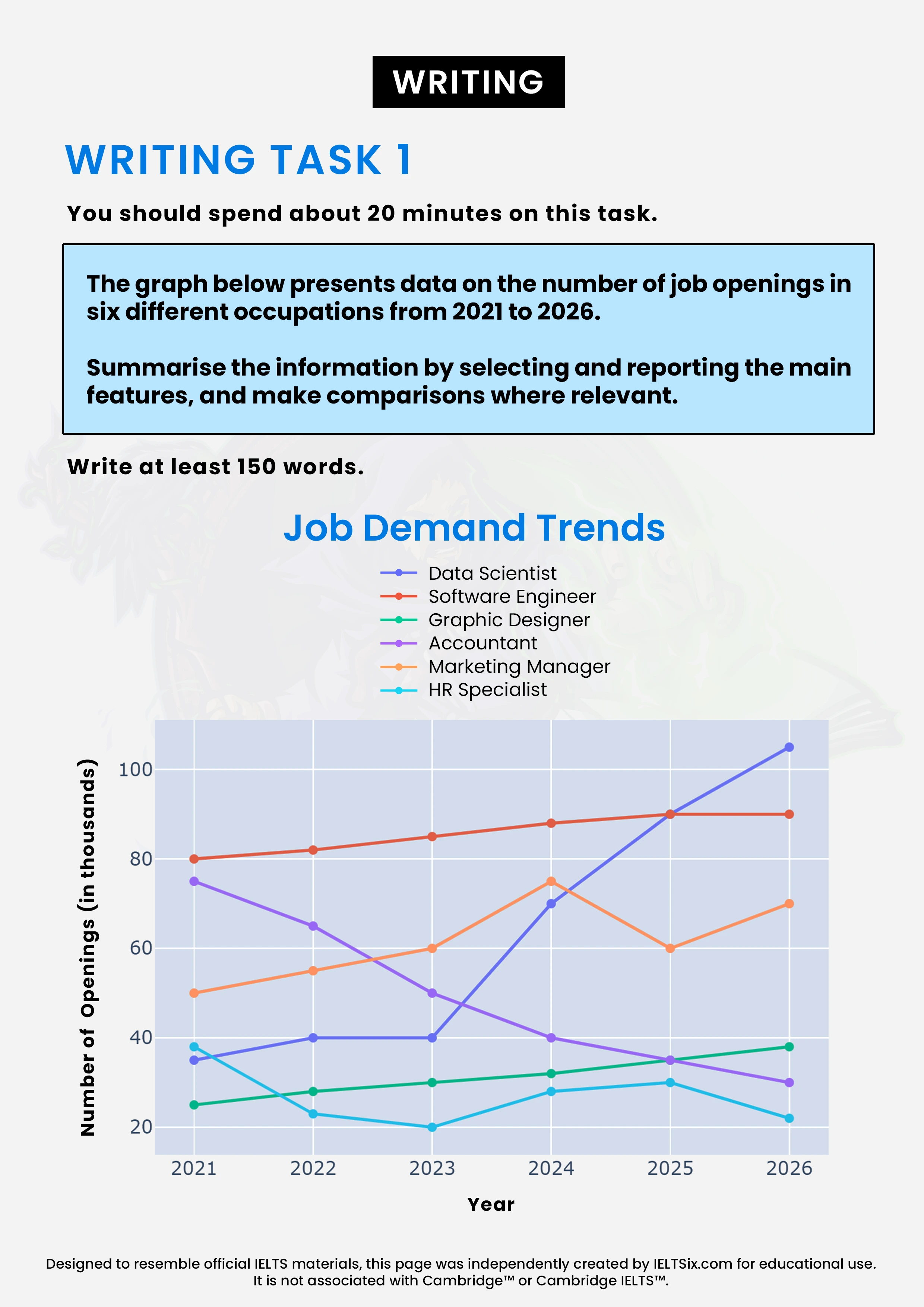
Instructions: You should spend about 20 minutes on this task.
The graph below presents data on the number of job openings in six different occupations from 2021 to 2026.
Summarise the information by selecting and reporting the main features, and make comparisons where relevant.
Write at least 150 words.
IELTS 21 Academic Writing Task 1: Test 2
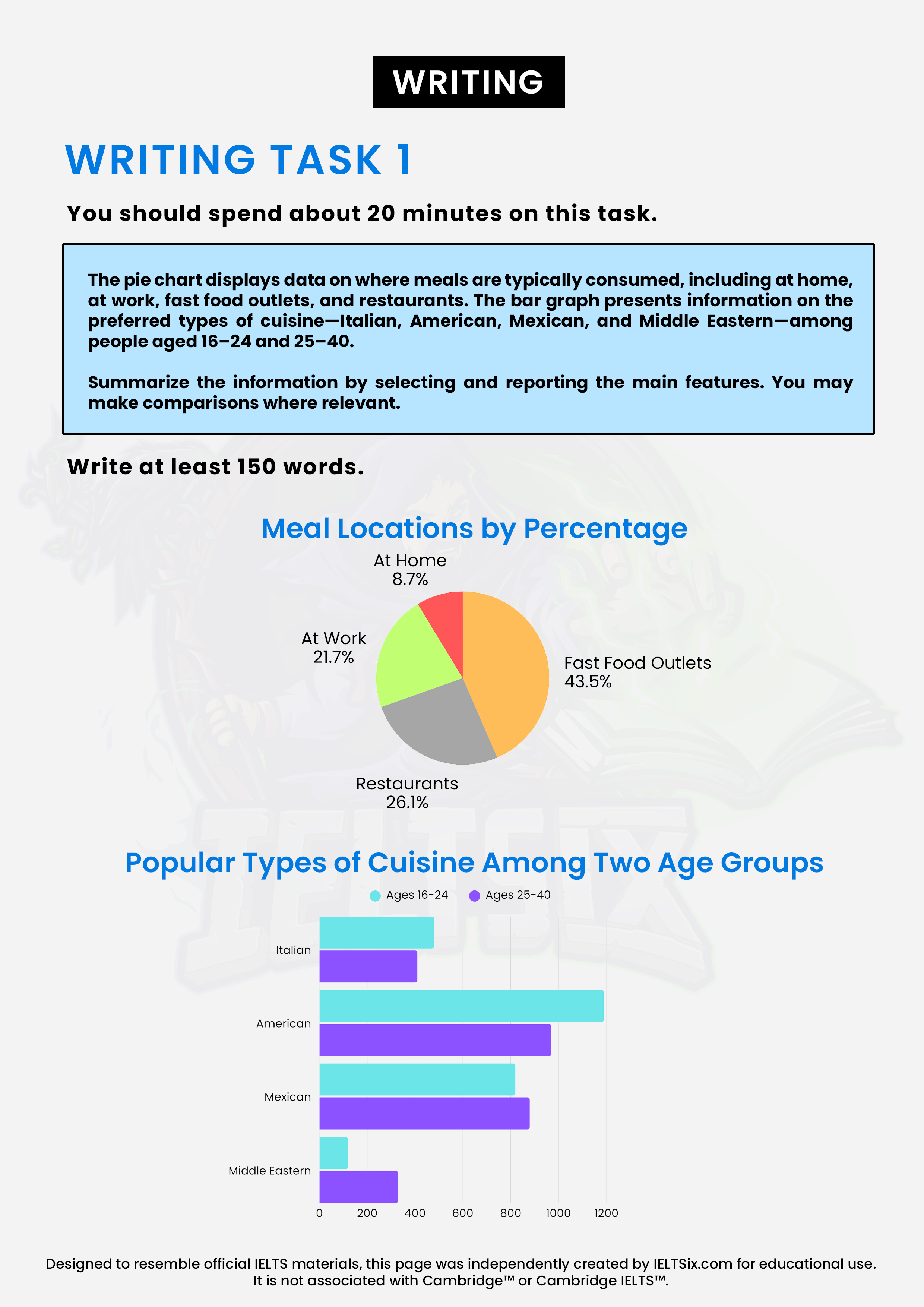
Instructions: You should spend about 20 minutes on this task.
The pie chart displays data on where meals are typically consumed, including at home, at work, fast food outlets, and restaurants. The bar graph presents information on the preferred types of cuisine—Italian, American, Mexican, and Middle Eastern—among people aged 16–24 and 25–40.
Summarize the information by selecting and reporting the main features. You may make comparisons where relevant.
Write at least 150 words.
IELTS 21 Academic Writing Task 1: Test 3
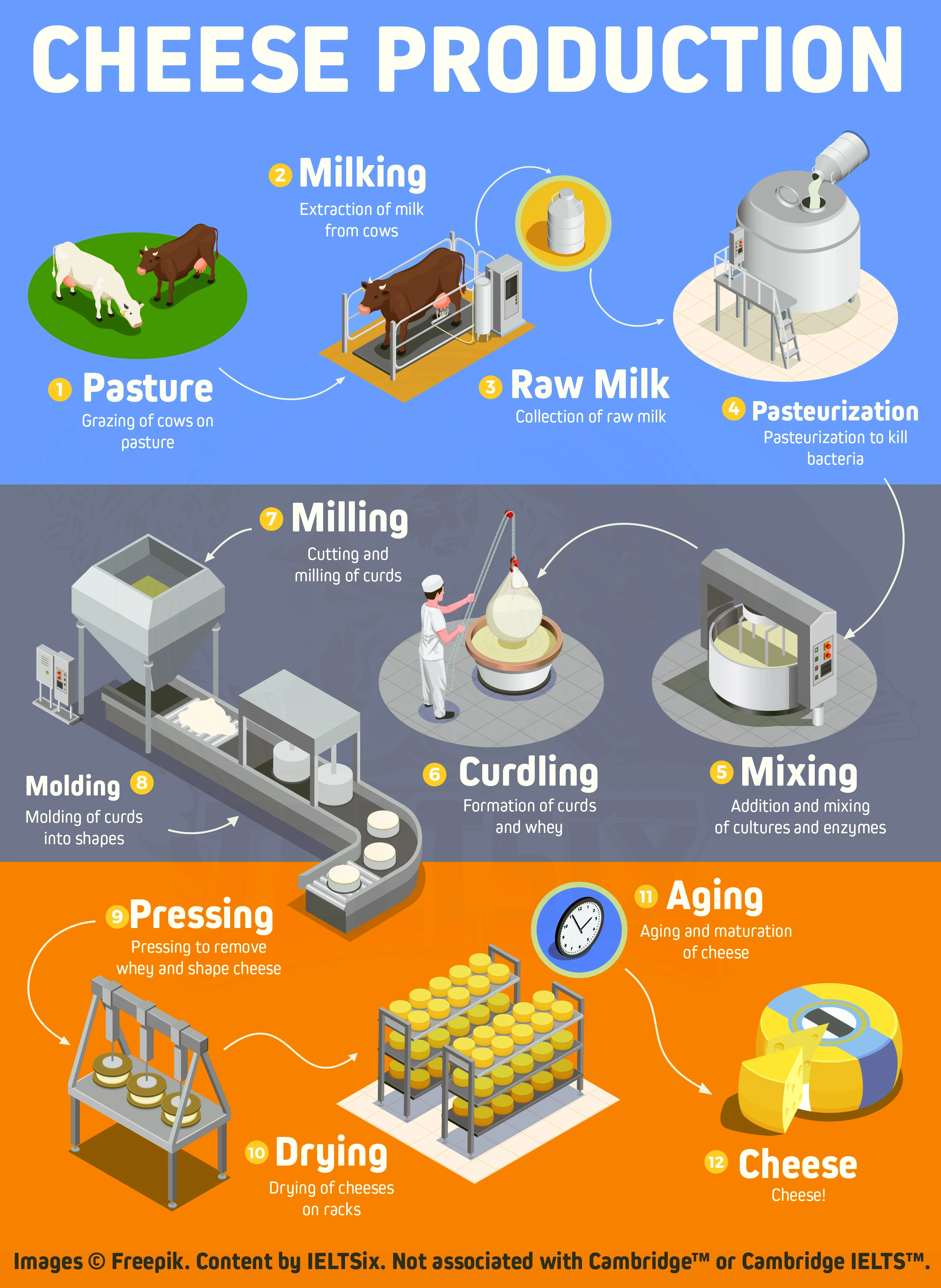
Instructions: You should spend about 20 minutes on this task.
The diagram below shows the process of cheese production, outlining the main stages from milk collection to the finished product.
Summarize the information by selecting and reporting the main features. You may make comparisons where relevant.
Write at least 150 words.
IELTS 21 Academic Writing Task 1: Test 4
Cambridge IELTS 21 Academic Writing Module (Task 2)
Cambridge IELTS 21 Academic, Test 1, Writing Task 2: Some people believe that governments should encourage people to live in smaller towns rather than in major cities in order to reduce pressure on urban infrastructure. To what extent do you agree or disagree?
Cambridge IELTS 21 Academic, Test 2, Writing Task 2: Some people think that museums should focus mainly on preserving historical objects, while others believe they should use modern technology to make exhibitions more entertaining and interactive. Discuss both views and give your own opinion.
Cambridge IELTS 21 Academic, Test 3, Writing Task 2: Many employers believe that graduates should spend a year developing practical skills before starting a full-time career. Do the advantages of this approach outweigh the disadvantages?
Cambridge IELTS 21 Academic, Test 4, Writing Task 2: Some people argue that schools should spend more time teaching students life skills such as financial management and communication than traditional academic subjects. To what extent do you agree or disagree? Which life skills do you think are most important for young people to learn?
Cambridge IELTS 21 General Training Writing Module (Task 1)
Cambridge IELTS 21 General Training, Test 1, Writing Task 1: You recently attended a short training course that did not fully meet your expectations. Write a letter to the course organizer. In your letter:
-describe the course you attended
-explain what disappointed you
-suggest how the course could be improved for future participants
Cambridge IELTS 21 General Training, Test 2, Writing Task 1: Your local library is planning to introduce several new services and has invited suggestions from members. Write a letter to the library manager. In your letter:
-recommend a new service or facility
-explain how it would benefit library users
-describe why you think it should be given priority
Cambridge IELTS 21 General Training, Test 3, Writing Task 1: You recently bought a piece of furniture online, but it arrived with several problems. Write a letter to the company’s customer service department. In your letter:
-describe the problems with the item
-explain how the issue has affected you
-say what action you would like the company to take
Cambridge IELTS 21 General Training, Test 4, Writing Task 1: A friend is planning to move to your town for work and has asked for your advice. Write a letter to your friend. In your letter:
-describe the area where you think they should live
-recommend places or activities they might enjoy
-give some advice about settling into the community
Cambridge IELTS 21 General Training Writing Module (Task 2)
Cambridge IELTS 21 General Training, Test 1, Writing Task 2: More people are choosing to shop at local businesses rather than large international chains. What are the reasons for this trend, and do you think it is a positive or negative development?
Cambridge IELTS 21 General Training, Test 2, Writing Task 2: Some people believe that employees should have the option to work a four-day week, while others think the traditional five-day schedule is more effective. Discuss both views and give your own opinion.
Cambridge IELTS 21 General Training, Test 3, Writing Task 2: Many people are spending less time cooking meals at home than they did in the past. What factors have contributed to this change, and what effects could it have on individuals and society?
Cambridge IELTS 21 General Training, Test 4, Writing Task 2: Some people think that communities have become less connected because people move more frequently for work or study. To what extent do you agree or disagree with this view?
Submit Your Writing
STUDY WITH ME
{{ is_error_msg }}
Duration: {{ service_details.bookingpress_service_duration_val }} {{ service_details.bookingpress_service_duration_label }}
Price: {{ service_details.bookingpress_service_price }}
{{ extra_service_error_msg }}
{{ is_error_msg }}
{{recurring_item.display_formated_date_and_time}}
{{recurring_edit_appointment_title}}
{{recurring_item.display_formated_date_and_time}}
{{recurring_edit_appointment_title}}
{{ is_error_msg }}
{{ is_error_msg }}
Your appointment booking summary
{{package_login_msg}}
{{ coupon_code_msg }}
{{ tip_apply_code_msg }}
{{ coupon_code_msg }}
{{ tip_apply_code_msg }}
{{package_login_msg}}
{{ coupon_code_msg }}
{{ tip_apply_code_msg }}
Pay Locally
PayPal
{{stripe_text}}
{{ is_error_msg }}
{{ is_error_msg }}
{{ staffmember_details.bookingpress_staffmember_email }}
{{ staffmember_details.bookingpress_staffmember_phone }}
OUR IELTS SHOP
-
Sale!
![Cambridge IELTS 21 | The Complete IELTS Guide [With Answers & Free Videos] 48 TOEFL Vocabulary Quiz Level 2 Thumbnail](https://ieltsix.com/wp-content/uploads/2025/06/TOEFL-Vocabulary-Quiz-Level-2-Thumbnail-300x300.webp?crop=1)
TOEFL Vocabulary Quiz #2: Essential Words [Premium]
$25.00Original price was: $25.00.$20.00Current price is: $20.00. -
Sale!
![Cambridge IELTS 21 | The Complete IELTS Guide [With Answers & Free Videos] 49 TOEFL Vocabulary Quiz Level 3 Thumbnail](https://ieltsix.com/wp-content/uploads/2025/06/TOEFL-Vocabulary-Quiz-Level-3-Thumbnail-300x300.webp?crop=1)
TOEFL Vocabulary Quiz #3: Intermediate Words [Premium]
$25.00Original price was: $25.00.$20.00Current price is: $20.00. -
Sale!
![Cambridge IELTS 21 | The Complete IELTS Guide [With Answers & Free Videos] 50 TOEFL Vocabulary Quiz Level 4 Thumbnail](https://ieltsix.com/wp-content/uploads/2025/06/TOEFL-Vocabulary-Quiz-Level-4-Thumbnail-300x300.webp?crop=1)
TOEFL Vocabulary Quiz #4: Advanced Words [Premium]
$25.00Original price was: $25.00.$20.00Current price is: $20.00. -
Sale!
![Cambridge IELTS 21 | The Complete IELTS Guide [With Answers & Free Videos] 51 TOEFL Vocabulary Quiz Level 5 Thumbnail](https://ieltsix.com/wp-content/uploads/2025/06/TOEFL-Vocabulary-Quiz-Level-5-Thumbnail-300x300.webp?crop=1)
TOEFL Vocabulary Quiz #5: The Most Challenging Words [Premium]
$25.00Original price was: $25.00.$20.00Current price is: $20.00. -
Sale!
![Cambridge IELTS 21 | The Complete IELTS Guide [With Answers & Free Videos] 52 TOEFL Vocabulary Quiz Level 1 Thumbnail](https://ieltsix.com/wp-content/uploads/2024/10/TOEFL-Vocabulary-Quiz-Level-1-Thumbnail-300x300.webp?crop=1)
TOEFL Vocabulary Quiz #1: Core Words [Premium]
$25.00Original price was: $25.00.$20.00Current price is: $20.00. -
![Cambridge IELTS 21 | The Complete IELTS Guide [With Answers & Free Videos] 53 IELTS Writing Task Lessons & Tutorials](https://ieltsix.com/wp-content/uploads/2024/08/IELTS-Writing-Task-Review-Score-Expert-Feedback-300x300.webp?crop=1)
IELTS Writing Task | Review, Score, & Expert Feedback [60-Minute Video Session]
$35.00 -
![Cambridge IELTS 21 | The Complete IELTS Guide [With Answers & Free Videos] 54 IELTS Speaking Test Simulation, Score, & Feedback](https://ieltsix.com/wp-content/uploads/2024/08/IELTS-Speaking-Mock-Test-Expert-Feedback-Score-Included-300x300.webp?crop=1)
IELTS Speaking Mock Test | Expert Feedback & Score Included
$35.00
Watch a few of my videos to see how I approach teaching and what you can expect.
Ready to Start Your English IELTS TOEFL SAT Journey?
TAKE IT TO THE NEXT LEVEL.