Cambridge IELTS 20 | Complete Guide With Video Tutorials & Answers

June 5th: The book has been added to the official Cambridge book store and you can purchase it here.Β Keep in mind that I will not be able to share copyrighted material. However, I will be able to use the new tests as a reference to create similar practice tests here. I also use the latest edition of the Cambridge IELTS series in my private lessons.

Comments are enabled on this page. You can share your responses, ask questions, and express your views.

July 22nd: at last!

IELTSix.com Cambridge IELTS 20 Physical Book

Table of Contents

Cambridge IELTS 20 Listening Module

English Quizzes (Coming Soon)

Cambridge IELTS 20 Reading Module

IELTS Reading Free Practice Test Passage [Based on Cambridge IELTS 20]
IELTS Reading Practice Test #14: A Quiet Shift Away from the Age of the Megacity
IELTS Reading Free Practice Test Passage [Based on Cambridge IELTS 20]
IELTS Reading Practice Test #15: When Multitasking Becomes a Modern Productivity Trap
IELTS Reading Free Practice Test Passage [Based on Cambridge IELTS 20]
IELTS Reading Practice Test #16: Fungi in Biotechnology and Their Emerging Applications
IELTS Reading Free Practice Test Passage [Based on Cambridge IELTS 20]
IELTS Reading Practice Test #17: Reassessing the Digital Native Concept in Contemporary Education
IELTS Reading Free Practice Test Passage [Based on Cambridge IELTS 20]
IELTS Reading Practice Test #18: Selective Attention and Its Role in Memory Encoding and Retrieval
IELTS Reading Free Practice Test Passage [Based on Cambridge IELTS 20]
IELTS Reading Practice Test #19: The Causes, Symptoms, and Coping Strategies for Jet Lag
IELTS Reading Free Practice Test Passage [Based on Cambridge IELTS 20]
IELTS Reading Practice Test #20: Mirror Neurons and the Foundation of Empathy and Communication
IELTS Reading Free Practice Test Passage [Based on Cambridge IELTS 20]
IELTS Reading Practice Test #21: How Animals Find Their Way Without Modern Technology
IELTS Reading Free Practice Test Passage [Based on Cambridge IELTS 20]
IELTS Reading Practice Test #22: What Science Says About Caffeine and Human Performance
IELTS Reading Free Practice Test Passage [Based on Cambridge IELTS 20]
IELTS Reading Practice Test #23: The Psychological Impact of Different Colors on Mood
IELTS Reading Free Practice Test Passage [Based on Cambridge IELTS 20]
IELTS Reading Practice Test #24: The Significance of Olfaction in Social and Dietary Behavior
IELTS Reading Free Official Practice Test Passage [Based on Cambridge IELTS 20]
IELTS Reading Practice Test #25: The Axolotl
IELTS Reading Free Official Practice Test Passage [Based on Cambridge IELTS 20]
IELTS Reading Practice Test #26: The Pangolin
IELTS Reading Free Official Practice Test Passage [Based on Cambridge IELTS 20]
IELTS Reading Practice Test #27: A Critical Look at the Rise of Plant-Based Meat Alternatives
IELTS Reading Free Official Practice Test Passage [Based on Cambridge IELTS 20]
IELTS Reading Practice Test #28: Charles Proteus Steinmetz: The Unsung Genius of Electrical Engineering
IELTS Reading Free Official Practice Test Passage [Based on Cambridge IELTS 20]
IELTS Reading Practice Test #29: Ada Lovelace: The Pioneering Mathematician Behind the First Computer Program
IELTS Academic Reading Full List of Practice Tests
Complete list of IELTS Reading Practice Tests With Quizzes & Explanations

IELTS Reading Practice Tests [With Quizzes & Answers]

IELTS Academic Reading Full List of Practice Tests

The IELTS Academic Reading section contains three academic passages and 40 questions to be completed in 60 minutes. It includes a range of question types such as multiple choice, matching headings, matching information, matching features, sentence completion, summary completion, short-answer questions, and True/False/Not Given. The section is designed to assess your understanding of main ideas, specific details, inferences, and the writer’s opinion or attitude.

The practice tests below are based on real exams from Cambridge IELTS 18, Cambridge IELTS 19, and Cambridge IELTS 20. Each one closely follows the original format, using authentic reading passages and official question types.

All tests are available as interactive quizzes with instant feedback and complete answer keys. These are meant to provide realistic practice and help you get used to the structure, timing, and difficulty level of the actual IELTS Reading section.

IELTS Reading Practice Test
IELTS Reading Practice Test #1: The Science of Sleep
IELTS Reading Practice Test [Inspired By Cambridge IELTS 19]
IELTS Reading Practice Test #2: The Dynamic Evolution of Running Shoe Technology
IELTS Reading Practice Test [Inspired By Cambridge IELTS 19]
IELTS Reading Practice Test #3: The Timeless Craft of Mechanical Watches
IELTS Reading Practice Passage [Based on Cambridge IELTS 19]
IELTS Reading Practice Test #4: The Threads of Trade and Culture
IELTS Reading Practice Passage [Based on Cambridge IELTS 19]
IELTS Reading Practice Test #5: The Rise and Fall of Feudalism in Medieval Europe
IELTS Reading Practice Passage [Based on Cambridge IELTS 19]
IELTS Reading Practice Test #6: Sparks of Change in a New Era
IELTS Reading Practice Passage [Based on Cambridge IELTS 19]
IELTS Reading Practice Test #7: A Journey Through Tradition and Taste
IELTS Reading Practice Passage [Based on Cambridge IELTS 19]
IELTS Reading Practice Test #8: The Art of Calligraphy
IELTS Reading Practice Passage [Based on Cambridge IELTS 19]
IELTS Reading Practice Test #9: How the Digital Revolution is Reshaping Economies and Cultures
IELTS Reading Practice Passage [Based on Cambridge IELTS 19]
IELTS Reading Practice Test #10: Understanding Black Holes and Their Role in Cosmic Phenomena
IELTS Reading Practice Passage [Based on Cambridge IELTS 19]
IELTS Reading Practice Test #11: The Rise and Fall of the Knightly Order in Medieval Europe
IELTS Reading Practice Passage [Based on Cambridge IELTS 19]
IELTS Reading Practice Test #12: Zombies as Reflections of Society's Deepest Anxieties
IELTS Reading Practice Passage [Based on Cambridge IELTS 19]
IELTS Reading Practice Test #13: Reimagining City Spaces Through Gardening
IELTS Academic Reading Full List of Practice Tests
Complete list of IELTS Reading Practice Tests With Quizzes & Explanations

Cambridge IELTS 20 Speaking Module

Disclaimer: To respect copyright laws, I can’t share the exact IELTS Speaking questions. Instead, I’ve rewritten them while keeping the original topics and ideas intact. The structure and focus are essentially the same.

These questions are based on the four speaking tests found in the Cambridge IELTS 20 Academic book. Fortunately, Cambridge can’t copyright broad topics like food or college life, though I’m sure their legal team wishes they could. They seem pretty intent on limiting students’ access to real test-prep material. By practicing with these reworded questions, you’ll still get realistic preparation without running into any copyright issues. If you can respond well to these, you’ll be in good shape for the real test.

Tests 1 to 4 are recreated to match the original tests as closely as legally allowed. Tests 5 to 8 are new tests I created based on the book’s tone, difficulty, and question style.

IELTS 20 Speaking: Test 1

IELTS 20 Official Test 1 Speaking

Part 1

  • Do you spend much time outdoors during the week?
  • What kinds of outdoor spaces are available near your home?
  • Did you spend more time outside as a child than you do now?
  • Would you ever consider going on a holiday focused on outdoor activities?

Part 2

Describe a performance or show you’ve seen that you would enjoy watching again with others.

-what was the performance or show?
-who would you like to see it with?
-what have other people said about it?

Explain why you would like to experience it again.

Part 3

A: Changes in Live Entertainment
-How have people’s preferences for entertainment changed in recent years?
-What challenges do traditional theatres face in the modern world?
-Do you think attending live events will remain popular in the future?

B: Working in the Arts
-Why do you think some people are drawn to creative careers?
-What are the difficulties faced by people who work in the performing arts?
-Should artistic professions receive more public funding or support?

IELTS 20 Speaking: Test 2

Cambridge IELTS 20 Official Speaking Questions (All 4 Tests)

Part 1

  • Which fruit do you enjoy eating the most?
  • Are there any fruits that you prefer not to eat? Why?
  • Do you like meals that include fruit as an ingredient?
  • Where do you usually buy fresh fruit near your home?

Β 

*You may think this is way too easy to be an IELTS question set… but it actually is!

Part 2

Describe a situation when you had to adjust your original plans unexpectedly.

-what were your initial plans?
-what caused you to change them?
-what new arrangements did you make?

Explain how you felt about having to make these changes.

Part 3

A: Social Planning and Friendship
-How do cultural differences influence the ways friends make plans?
-What difficulties can arise when friends have different priorities in planning activities?
-In what ways has technology changed how young people arrange their social plans?

B: Career Planning and Flexibility
-How might changes in the job market affect how people choose their careers?
-What influence do family expectations and societal norms have on career decisions?
-Why is it important for individuals to be adaptable and consider changing careers during their working lives?

IELTS 20 Speaking: Test 3

Cambridge IELTS 20 Official Speaking Questions (All 4 Tests)

Part 1

  • How often did you visit museums or galleries during your childhood? (Why/Why not?)
  • Are there any cultural or historical museums near your home? (Why/Why not?)
  • Would you rather explore a museum by yourself or with a group? (Why/Why not?)
  • When traveling, do you think it’s important to learn about the local history through museums? (Why/Why not?)

Part 2

Describe an academic or work project that you found particularly rewarding.

-What was the nature of this project?
-What motivated you to undertake this work?
-Who or what supported you while you completed it?

Explain why finishing this project was meaningful to you.

Part 3

A: Factors Influencing Personal Satisfaction
-What are some reasons people might feel unfulfilled in their personal lives?
-Can setting personal goals ever lead to negative consequences? How?
-In your opinion, what elements contribute most significantly to a person’s overall happiness?

B: Job Satisfaction and Career Development
-Besides money, what aspects of a job contribute to an employee’s contentment?
-How important is it for employees to seek new opportunities to maintain their enthusiasm at work?
-Is it realistic to expect to find satisfaction in all professions? Why or why not?

IELTS 20 Speaking: Test 4

Cambridge IELTS 20 Official Speaking Questions (All 4 Tests)

Part 1

  • What personal traits do you value most in yourself? (Why?)
  • Do you think your personality is similar to your parents’? (Why/Why not?)
  • Which personal qualities do you look for when choosing close friends? (Why?)
  • In your opinion, what qualities are essential for someone to be a good leader? (Why?)

Part 2

Describe a time when you had a lengthy conversation about a recent event or issue in your community.

-What was the event or issue about?
-Who did you talk with?
-What different views did people share?

Explain why this discussion lasted a long time and why it was important to you.

Part 3

A: Media Consumption and Information
-What are the main ways people stay informed about current events in your country?
-Do you think people pay more attention to news that directly affects their local area or to wider national news? Why?
-How significant is it for citizens to be aware of global issues, and why?

B: Impact of Public Discussion Shows
-Why do you think talk shows and debate programs attract so many viewers and listeners?
-What motivates ordinary people to participate in these public discussions?
-In your opinion, do these discussion programs generally have a positive or negative effect on public opinion? Explain.

IELTS 20 Speaking: Test 5

Cambridge IELTS 20 Free Speaking Questions (All 4 Tests)

Part 1

  • What kind of weather do you usually experience in your hometown? (Why/Why not?)
  • Do you enjoy hot weather or cold weather more? (Why/Why not?)
  • Does the weather ever affect your daily plans or activities? (Why/Why not?)
  • Have you ever had to change your plans because of extreme weather? (Why/Why not?)

Part 2

Describe a building in your country that you think is especially interesting or unique.

-What is the name of the building?
-Where is it located?
-What makes it stand out from other buildings?

Why do you think this building attracts so much attention?

Part 3

A: Architecture and National Identity
-How do iconic buildings reflect the culture or history of a country?
-Should governments invest in preserving traditional architecture?
-What effect can modern architecture have on a city’s image?

B: The Role of Architects
-Do architects receive enough recognition for their work?
-What skills are most important for someone working in architecture?
-Should famous architects be involved in designing public spaces like parks and schools?

IELTS 20 Speaking: Test 6

Cambridge IELTS 20 Free Speaking Questions (All 4 Tests)

Part 1

  • What types of clothes do you usually wear? (Why/Why not?)
  • Do you like shopping for clothes? (Why/Why not?)
  • How much attention do you pay to fashion trends? (Why/Why not?)
  • Do people dress differently in your country depending on the occasion? (Why/Why not?)

Part 2

Describe a traditional craft or skill from your country that fewer people are learning today.

-What is the craft or skill?
-Why was it important in the past?
-Why do you think it’s becoming less common?

Do you think it should be preserved for future generations?

Part 3

A: Cultural Heritage and Education
-Should schools teach students about traditional crafts and skills?
-How can governments encourage young people to value cultural heritage?
-What challenges are there in keeping traditional knowledge alive?

B: Economic Value of Traditional Skills
-Can traditional crafts still be profitable in today’s economy?
-How can tourism help preserve disappearing local industries?
-Should artisans receive public funding or government support?

IELTS 20 Speaking: Test 7

Cambridge IELTS 20 Free Speaking Questions (All 4 Tests)

Part 1

  • Have you ever owned a pet? (Why/Why not?)
  • What kinds of animals are common in your region? (Why/Why not?)
  • Do you prefer wild animals or pets? (Why/Why not?)
  • Would you consider having a pet in the future? (Why/Why not?)

Part 2

Describe a book or film that taught you something important.

-What is it about?
-When did you read or watch it?
-What lesson or message did it give you?

How has it influenced your thinking or behavior?

Part 3

A: Storytelling and Education
-How effective is fiction as a tool for teaching real-life values or lessons?
-Should schools include more novels and films in their curriculum?
-What are the risks of learning from fictional stories instead of real experiences?

B: Media and Public Opinion
-How do films or books influence the way people view social issues?
-Can a single movie or book change public opinion?
-Should creators be responsible for how their stories affect society?

IELTS 20 Speaking: Test 8

Cambridge IELTS 20 Free Speaking Questions (All 4 Tests)

Part 1

  • Do you often visit the library? (Why/Why not?)
  • Do you prefer reading at home or at the library? (Why/Why not?)
  • What kinds of books do you usually borrow from the library? (Why/Why not?)
  • Has your use of libraries changed since you were younger? (Why/Why not?)

Part 2

Describe a time when you changed your opinion about something or someone.

-What was the original opinion you had?
-What caused you to change your mind?
-How did this change affect you?

Was it difficult for you to change your opinion? Why or why not?

Part 3

A: Open-Mindedness and Growth
-Why do some people find it hard to change their opinions?
-How can open-mindedness be encouraged in education or work environments?
-Is it better to hold firm beliefs or to be flexible?

B: Influence of Media and Social Circles
-What role does media play in shaping people’s opinions?
-Do you think friends and family influence your beliefs more than experts?
-How can people learn to think more critically about the information they receive?

Cambridge IELTS 20 Speaking Module Sample Answers

I’m currently working on preparing the sample answers for the Cambridge IELTS 20 Speaking Module. In the meantime, click here to access detailed sample answers, scoring criteria, and thorough explanations for every part of the IELTS Speaking section from Cambridge IELTS 19. This page covers all the questions from 4 tests in book 19 and offers both high-level and mid-to-low-level spoken responses with audio. Transcripts are also provided to help you follow along and improve your speaking skills effectively.

Cambridge IELTS 20 Writing Module

Disclaimer: For the writing section, just like in the speaking section above, I’ve created original questions that reflect the style and structure of the official prompts, giving you realistic, high-quality practice while avoiding any copyright issues. The core ideas remain intact to help you build real exam skills. You can use the form below to submit your writing. If you’d like professional feedback, including estimated scores or a real-time video review, you can place an order here.

Click here to access high-level and mid-level sample responses for both Writing Task 1 and Task 2 from Cambridge IELTS 20. Each sample is accompanied by detailed examiner notes that assess the writing according to official IELTS scoring criteria, covering task achievement or task response, coherence and cohesion, lexical resource, and grammatical range and accuracy. The complete guide to Cambridge IELTS 19 Writing is also available here.

These notes highlight strengths and weaknesses to help you understand what examiners look for and how to improve your own writing. For more on the scoring system, you can refer to the official IELTS Writing Band Descriptors and IELTS Writing Key Assessment Criteria provided by IELTS.

Cambridge IELTS 20 Academic Writing Module (Task 1)

IELTS 20 Academic Writing Task 1: Test 1

Cambridge IELTS 20 Test 1 Writing Task 1 Free Sample Question (Based on Cambridge IELTS 20)

Instructions: You should spend about 20 minutes on this task.

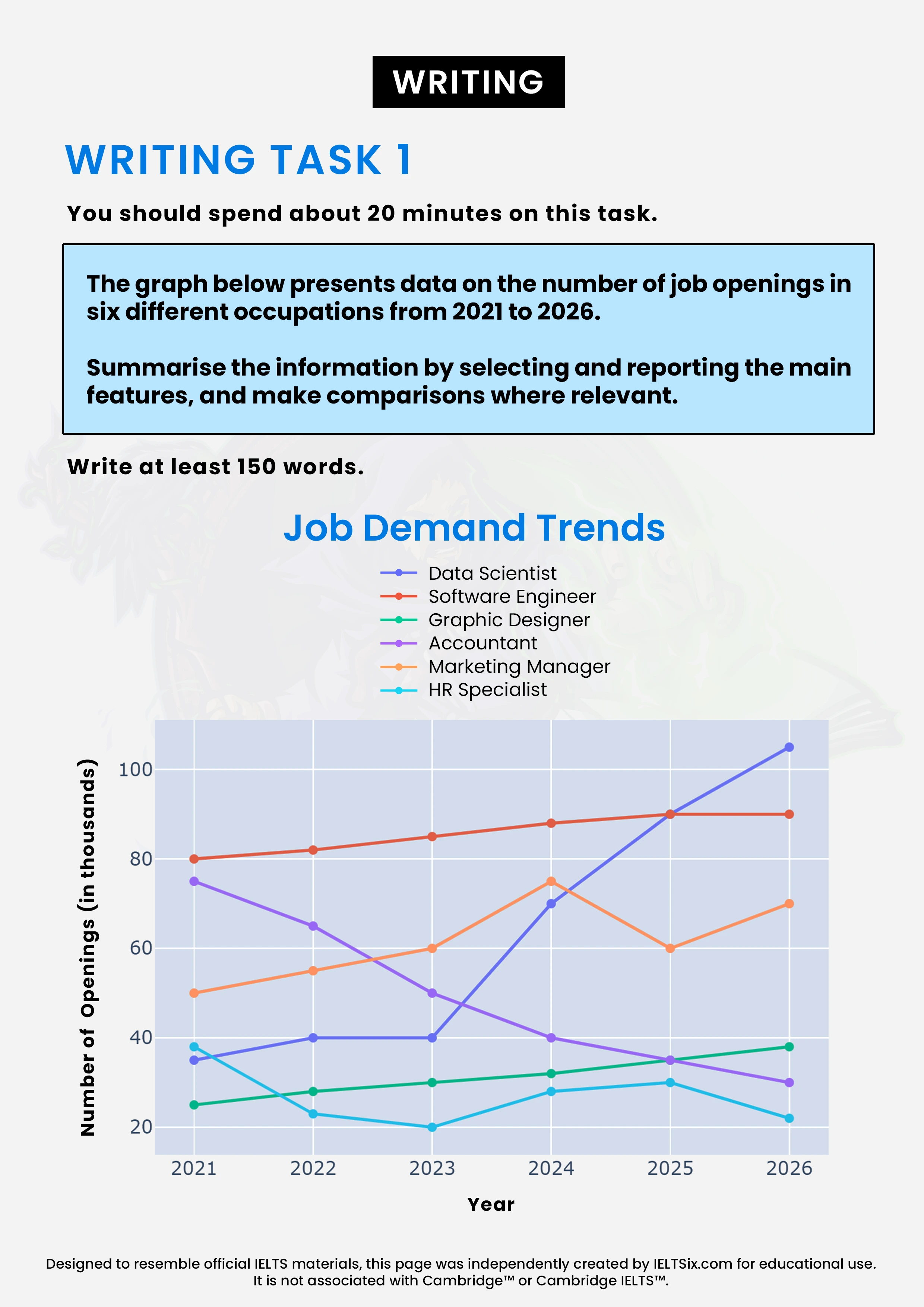
The graph below presents data on the number of job openings in six different occupations from 2021 to 2026.

Summarise the information by selecting and reporting the main features, and make comparisons where relevant.

Write at least 150 words.

IELTSix Cambridge IELTS 20 Free Practice Test 1 Writing Task 1
View the image in full size by clicking on it.

IELTS 20 Academic Writing Task 1: Test 2

Cambridge IELTS 20 Test 2 Writing Task 1 Free Sample Question (Based on Cambridge IELTS 20)

Instructions: You should spend about 20 minutes on this task.

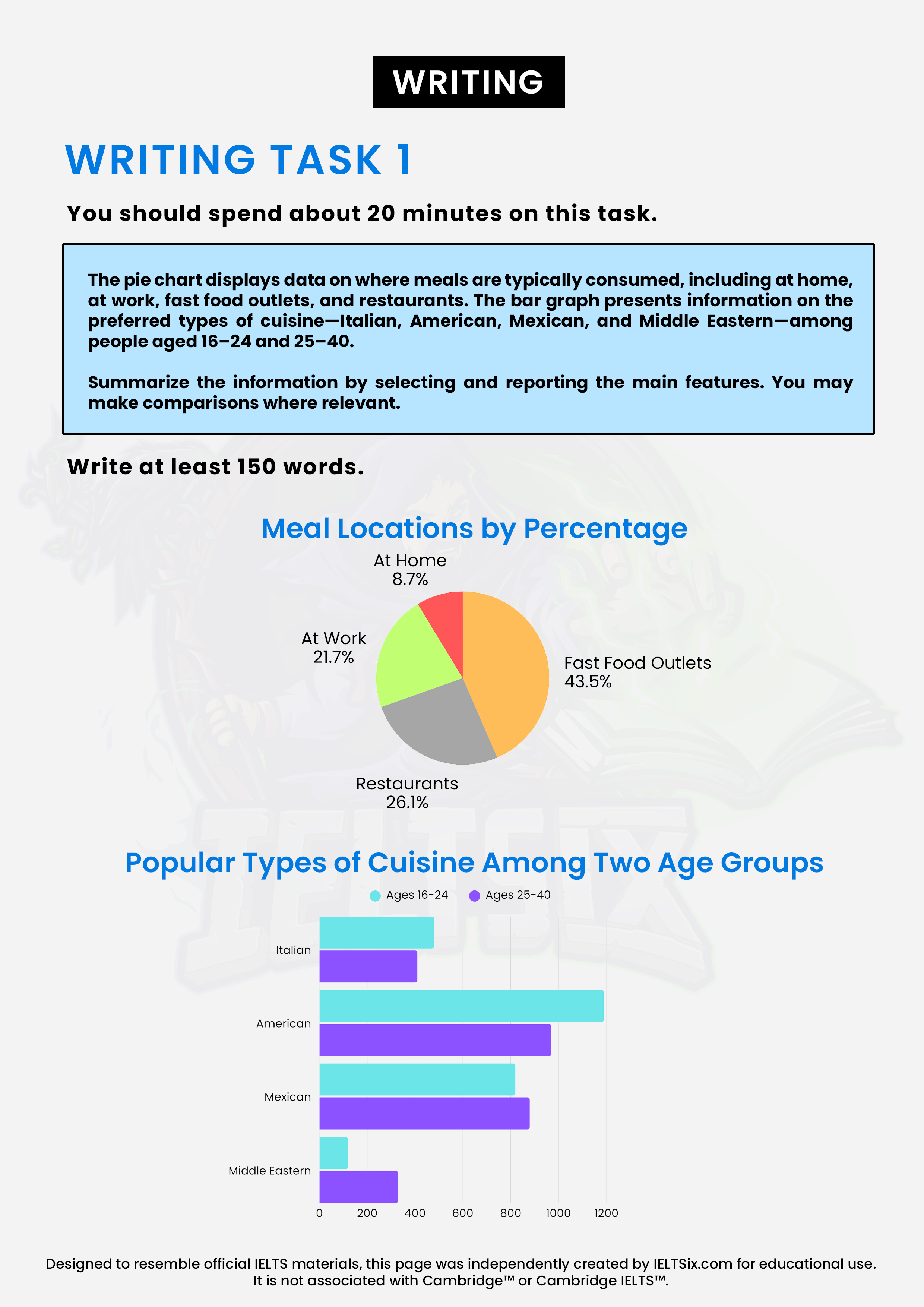
The pie chart displays data on where meals are typically consumed, including at home, at work, fast food outlets, and restaurants. The bar graph presents information on the preferred types of cuisineβ€”Italian, American, Mexican, and Middle Easternβ€”among people aged 16–24 and 25–40.

Summarize the information by selecting and reporting the main features. You may make comparisons where relevant.

Write at least 150 words.

IELTS 20 Test 2 Writing Task 1 Free Sample Question (Based on Cambridge IELTS 20)
View the image in full size by clicking on it.

IELTS 20 Academic Writing Task 1: Test 3

Cambridge IELTS 20 Test 3 Writing Task 1 Free Sample Question (Based on Cambridge IELTS 20)

Instructions: You should spend about 20 minutes on this task.

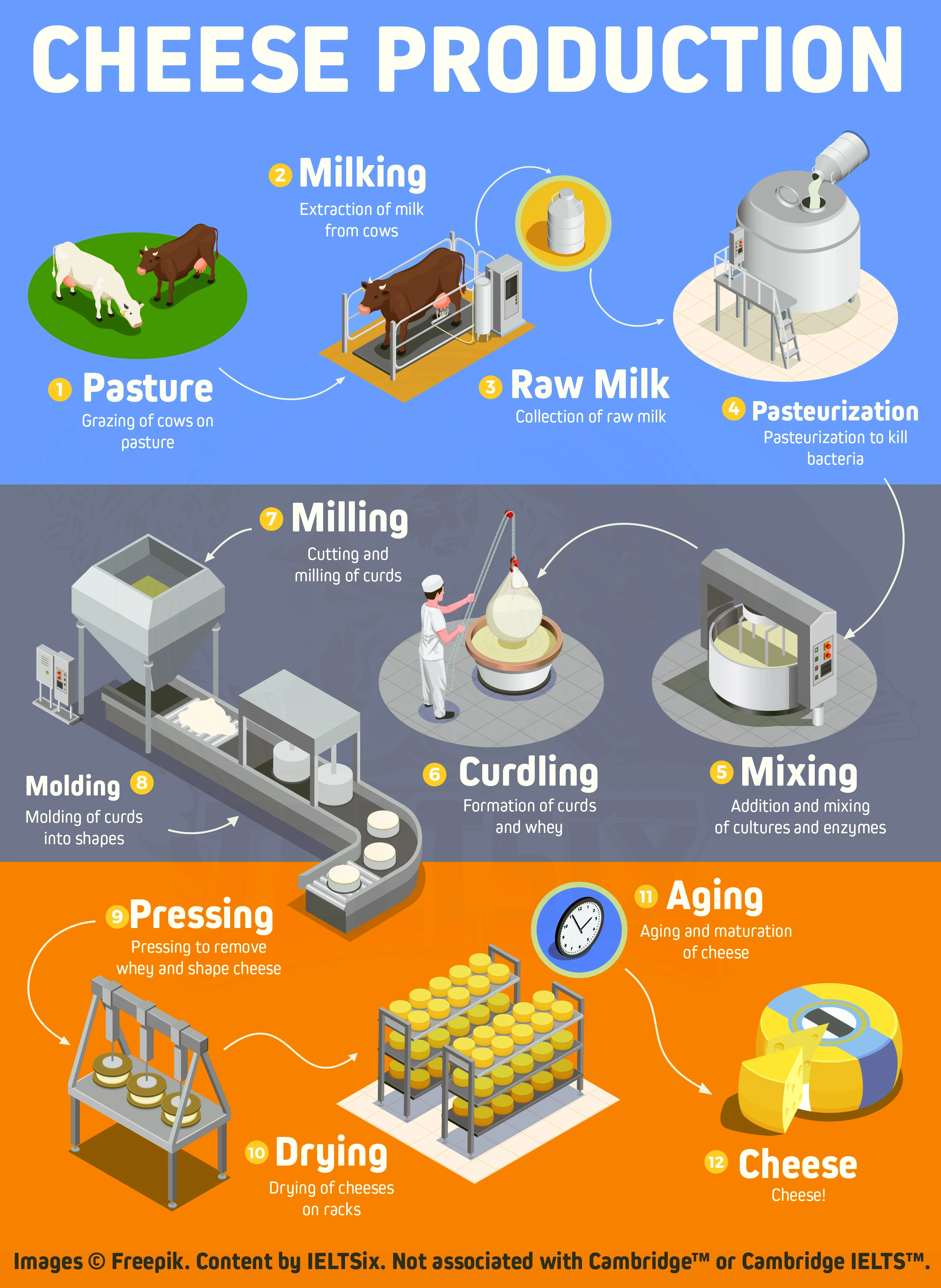
The diagram below shows the process of cheese production, outlining the main stages from milk collection to the finished product.

Summarize the information by selecting and reporting the main features. You may make comparisons where relevant.

Write at least 150 words.

IELTS 20 Test 3 Writing Task 1 Free Sample Question (Based on Cambridge IELTS 20)
View the image in full size by clicking on it.

IELTS 20 Academic Writing Task 1: Test 4

English Quizzes (Coming Soon)

Cambridge IELTS 20 Academic Writing Module (Task 2)

Cambridge IELTS 20 Academic, Test 1, Writing Task 2: Some argue that advertising has too much influence on people’s purchasing decisions. To what extent do you agree or disagree with this view?

Cambridge IELTS 20 Academic, Test 2, Writing Task 2: In many countries, there is growing concern about the effects of screen time on children. What problems can this cause, and what solutions might be effective?

Cambridge IELTS 20 Academic, Test 3, Writing Task 2: Many people today use digital platforms to learn new skills instead of attending traditional classes. Do the advantages of online learning outweigh the disadvantages?

Cambridge IELTS 20 Academic, Test 4, Writing Task 2: Some people believe that curiosity is the key driver of innovation, while others think it is necessity. Discuss both views and give your own opinion.

Cambridge IELTS 20 General Training Writing Module (Task 1)

Cambridge IELTS 20 General Training, Test 1, Writing Task 1: You recently stayed at a hotel and want to give feedback to the manager. Write a letter to the hotel manager. In your letter:
-describe your experience during the stay
-mention what you liked and what could be improved
-suggest any changes that would make the hotel better for future guests

Cambridge IELTS 20 General Training, Test 2, Writing Task 1: Your city council is planning to build a new park and asks residents for suggestions. Write a letter to the council. In your letter:
-suggest what facilities or features the park should include
-explain why these would be useful or popular
-offer ideas on how to maintain the park effectively

Cambridge IELTS 20 General Training, Test 3, Writing Task 1: You want to change your mobile phone service provider. Write a letter to your current provider. In your letter:
-explain why you are considering switching providers
-ask about options for staying with the company
-mention any problems or concerns you have had with the service

Cambridge IELTS 20 General Training, Test 4, Writing Task 1: You have recently joined a local volunteer group and want to recruit new members. Write a letter to a friend. In your letter:
-explain what the volunteer group does
-suggest how your friend could get involved
-describe the benefits of volunteering in this group

Cambridge IELTS 20 General Training Writing Module (Task 2)

Cambridge IELTS 20 General Training, Test 1, Writing Task 2: Popular natural parks are experiencing damage due to the large number of visitors. What challenges does this bring, and what measures can be taken to preserve these areas?

Cambridge IELTS 20 General Training, Test 2, Writing Task 2: Renting items such as vehicles and electronics is becoming increasingly popular. What are the reasons for this trend, and do you think it is beneficial or harmful?

Cambridge IELTS 20 General Training, Test 3, Writing Task 2: More people are choosing to grow their own vegetables and herbs at home. Why is this happening, and what impact could it have on health and the environment?

Cambridge IELTS 20 General Training, Test 4, Writing Task 2: Some argue that social networking sites bring people closer together, while others believe they contribute to loneliness. Discuss both sides and provide your own view.

Cambridge IELTS Book Series

Cambridge IELTS 15 Academic & General Training Book Practice Tests
Cambridge IELTS 15
Cambridge IELTS 16 Academic & General Training Book Practice Tests
Cambridge IELTS 16
Cambridge IELTS 17 Academic & General Training Book Practice Tests
Cambridge IELTS 17
Cambridge IELTS 18 Academic & General Training Book Practice Tests
Cambridge IELTS 18
Cambridge IELTS 19 Academic & General Training Book Practice Tests
Cambridge IELTS 19
Cambridge IELTS 20 Academic & General Training Book Practice Tests
Cambridge IELTS 20
Meet Your Tutor Before You Decide

Watch a few of my videos to see how I approach teaching and what you can expect.

Ready to Start Your English IELTS TOEFL SAT Journey?

CHALLENGE YOURSELF.
TAKE IT TO THE NEXT LEVEL.

3 Responses

  1. It is extremely, extremely, extremely, extremely, extremely, extremely, extremely, extremely, extremely, extremely, extremely, extremely, extremely luxurious.

Leave a Comment