Cambridge IELTS 19 | The Ultimate IELTS Guide With Video Tutorials & Answers
Table of Contents
Cambridge IELTS 19 Listening Module
Note: the following section was published before the release of the audio files of the book. The most important thing during the preparation is for you to know what information to look for and what to ignore. Guessing isnβt about finding the correct answer, although itβs satisfying when it happens!, but about getting a sense of what we can ignore and what we need to look for in the conversation.
Test 1: Part 1
A great way to practice for the Listening module of the IELTS is to guess the possible answers before hearing the audio clips. I did not have access to the listening files of the book when this article was published, which made this a perfect practicing and teaching opportunity. Trying to answer without listening to the audio is something I commonly practice with students in my lessons. There are times when a student guesses half or even more of the answers correctly before hearing the conversation. Let’s begin.
- Hectare is a unit of area. We can say a piece of land is 20,000 square meters, or 2 hectares. That means the answer to question 1 is a number, and probably not a very large one. If I were taking notes, I would leave a small # sign next to this one, reminding me that the answer is very likely to be a small number.
One way the test tries to make the number questions more challenging is by providing 2-3 different numbers. In this case, they may represent the areas of different parks, or the area before/after some land was purchased or sold. - Lakes, ponds, and a …
We are talking about bodies of water so I expect the answer to be one of the following:
Ocean, sea, lake, river, pond, stream, bay, canal, reservoir.
Obviously, ocean is not a possible answer, and lake and pond have already been used. Other possible answers for me could be a waterfall or maybe a spring. In “one word only” questions, you should ignore the adjectives the speaker may use to describe the answer. - It’s an “educational visit”, a place for children to learn things about nature. This time instead of nature, we are thinking about a building, and the objects in it. The answer can be an information medium like books, movies, cartoons, etc. However, the verb “look” makes it unlikely for movies and cartoons to be the answer. We can look at pictures, photographs, posters, drawings, paintings, and displays.
- It’s an object related to geography. The fact that it’s in the same sentence with a compass makes it very likely for the object to have similar usages and purposes. My guesses would be maps, atlases, globes, or maybe even telescopes. Keep in mind that the sentence is looking for a singular noun (a …) so the answer will not have an -s or -es in the end. They have given the article “a” which makes it impossible for “atlas” to be the answer as it requires the article “an”.
- Although knowing the topic (leisure and tourism) makes it easier to guess in most cases, it’s quite challenging to come up with a good guess for a question like this promptly. I’d either skip this one or write down the first word that comes to mind. Attractions, facilities, amenities, wildlife!
- Instruments! It’s something children craft by hand, using natural materials (like wood), to help them learn about rhythm. The answer is most likely “instruments,” or specific musical instruments such as flutes or drums. Keep in mind that the question doesn’t include “a/an”, so the answer is likely to be plural.
Update (9.29.2024): I find it quite interesting how many students think about this question in a completely different way. Their guesses usually include sound, noises, melodies, songs, etc. - It’s a positive feeling (benefit). Something that people feel while in nature (outdoor educational visits). Peace, joy, harmony, serenity.
- Skills! In the test, I’d just write skills and move on. However, the answer can also be something like tricks or information.
- Number. Similar to question 1. They will most likely give you the price for different age groups or prices with and without a discount. It’s also possible that the speaker corrects himself/herself. Write down every number you hear so that it’s easier to recall in case that happens. Sometimes they repeat the correct answer, sometimes they don’t.
- This is an interesting one. Usually it’s free for kids, and adults are the ones who have to pay. Maybe guardians, nurses, teachers! I wouldn’t spend a long time on this one since it’s very clear what we are looking for but the range of answers we can have is very wide.
Test 1: Part 2
- In the first section of part 2, the prompts are relatively short and easy to summarize. In this question, “going to a”, “experiencing a”, and “visiting a” are not adding any context. They could all be removed with no consequences. Members enjoyed the theme park. Members enjoyed a river trip. Members enjoyed the cheese factory. It’s very unlikely for the test to mention different locations, so I assume all 3 options are in France. The word “especially” needs some attention. The members may have enjoyed all 3 trips, but they especially enjoyed one. It was the most enjoyable. In this section of the test, you don’t have to worry too much about the speakers using synonyms of the words mentioned in the prompts.
- What will happen? I expect the speaker to talk about the past and the future. Two of the three options have probably already happened or will never happen. One is being considered or is planned for the future. It’s a good idea to not pay attention to the verbs. For me, the options are: tree, a seat (don’t think about the word garden since it has the same theme as the tree), and a footbridge.
- Keyword: most. All three options have raised money, so there would be no wrong answers if the question hadn’t used the word “most”. However, just like with question 1, we need to know which one raised the highest amount of funds.
- It’s possible for some options to not be advised. However, since all three seem to be rather safe activities, I assume that’s not what the speaker will focus on. The two words that get my attention are “first” and “evening”. The speaker will most likely talk about events happening on different days of the trip, or the morning/afternoon/night of the first day.
- Just like the previous question, I expect them to mention the two wrong options for different days of the week.
Β
Update (9.29.2024): In summary, to do well on this type of question, it’s important to understand how the answer choices are constructed and what makes one of them correct while the others are not. A common trick is to include wrong options that refer to a different timeframe than the one mentioned in the question. For example, if the question asks about the present, a wrong choice might describe something from the past or future. These statements may be factually accurate, but they donβt match what the question is specifically asking.
Another strategy is including multiple answer choices that are all technically true, but each refers to a different subject. For instance, a question might ask βWhen will the visitors arrive on the island?β but the speaker mentions arrival times for the visitors, the tour guides, and the manager, all on different days. Or if the question is βHow long will the education course last?β the speaker might mention that it takes 3 days to prepare the course, the course itself runs for 5 days, and the cleanup afterward takes 7 days. Youβll often see options like β3 days,β β5 days,β and β7 days.β While all three are mentioned, only one directly answers the actual question.
Advertisement
Here is a video providing a detailed explanation of the map question from test 4 of book #15 taken from my Cambridge IELTS 15 walkthrough package. In this type of question, they generally discuss the past and present or present and future state of a park or a building. Pay attention to phrases like “we hope to … in the future.” or ” … used to be …”.
Test 1: Part 3
Part 3 of the listening module tends to be harder than part 4 for a lot of my students.
From what I’ve seen after teaching hundreds of students, the most challenging part of the Listening modules for test-takers is not part 4, but part 3. In this section, you will not only have to listen to opinions and ideas from two different speakers but also have to know how they feel about each of their own and the opposing side’s thoughts.
What to look for in the questions?
While reading the questions, underline the person whose opinion we are looking for. The speakers are always a guy and a girl to make it easier for you to know who is who. They tend to use popular names like Bob and Jennifer. Some questions mention one of their names, or they may mention “students” or “both.” You should also mark verbs like agree/disagree and adjectives like shocked/shocking, surprised/surprising, and phrases like “… expected …” or “… didn’t expect …”.
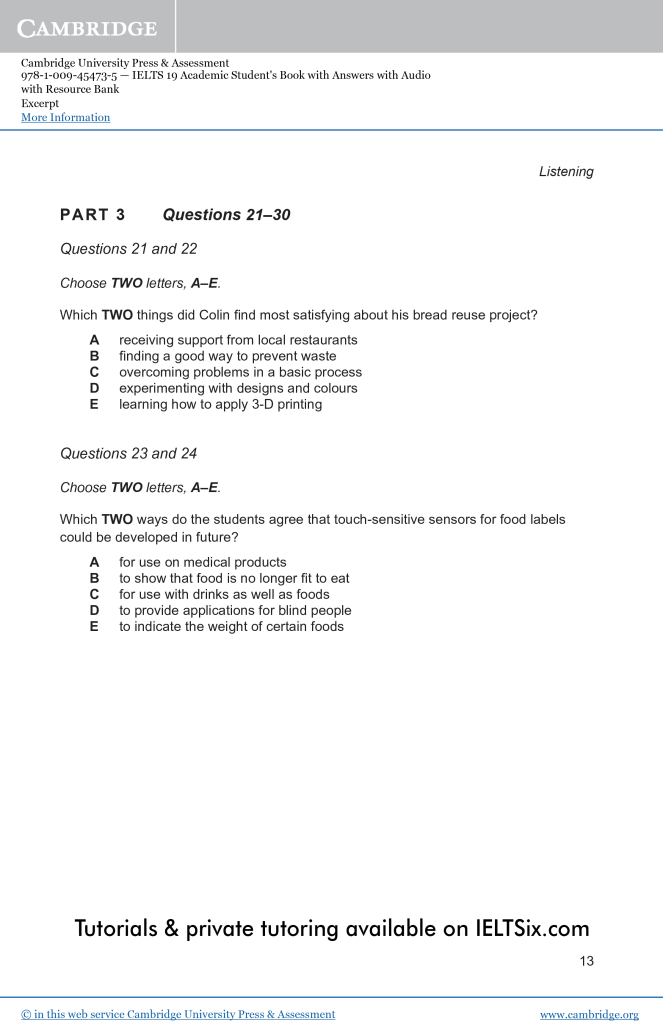
Questions 21 & 22
Colin! We are going to mark an option as correct only if the boy, Colin, finds it satisfying. In these types of questions, all 5 options will be mentioned one way or the other. The speaker (the one that we care about) may find some of the options unsatisfying or even annoying. The other speaker, the one that we ignore, may find some of the options satisfying, but that will not make those options the correct answer.
It’s also possible for Colin to find more than 2 options satisfying. However, he will have stronger feelings regarding the two answers. He may say something like “Although I found option C satisfying, it wasn’t the most enjoyable part of this project for me.” or “option B was really fun, and I found it satisfying, but it wasn’t my favorite part of the project.”
Questions 23 & 24
In these types of questions, you need 2 confirmations to mark an answer as correct. Students should agree with each other on two of the options. Colin may start by saying that he is confident that option C will be a reality in the near future. We will put one checkmark in front of the answer and wait for the girl’s reaction. If she agrees, circle that option and wait for the next option to be mentioned. If she disagrees, cross the option and move on.
In this type of question, you are being tested on the vocabulary used in the prompts’ box. Recognize the words that are likely to be the focus of the test designers and think of their synonyms. Also, think of other ways you could express each of the prompts.
Financial Support
While talking about “financial support“, any of the following may be mentioned: loan, aid, money, investment, capital, etc. Instead of saying more financial support is needed for this (“this” being the food trend we are talking about, options 25-30), they may say any of the following:
– They need to seek increased monetary aid to support their initiatives.
– It’s crucial to secure additional funding to sustain their projects.
– They should advocate for greater financial backing to ensure the success of their endeavors.
– Their efforts would benefit a lot from an infusion of additional financial resources.
– They should constantly pursue avenues to secure more funding for their activities.
Widespread
The speakers are likely going to mention words like common, prevalent, ubiquitous, universal, omnipresent, etc. They may also say things like “oh, everyone in the world does this” or “people all around the globe know about…”.
“Only relevant to young people”, disappointing results, retailers, encourage, “know little about*”, “stricter regulations”, and “dangerous” are the words and terms I’d personally focus on.
*I recommend learning the difference between “few” and “a few,” and between “little” and “a little.”
Advertisement
Test 1: Part 4
- A bog is a wetland with lots of vegetation. Maybe sand, plants, or vegetation. I assume most stones were sands in the past. Or vice versa. Obviously, I’m not good at science! :'(
- We are talking about a person (who became an archaeologist). His friend, student (we know that the guy was a teacher), pupil, father, son, etc. Most likely it’s someone younger than the teacher so father or professor can’t be good answers.
- What do we dig for? treasure!
But of course that’s very unlikely. The answer can be water, fossils, artifacts, oil, gems, gold, or some other underground material. - Oxygen? We are talking about a marsh or a wetland with lots of dead vegetation under water. Usually what helps objects decay is oxygen so I would assume that lack of oxygen will help preserve them, just like how a vacuum bag helps preserve food. Lack of heat, light, or sunlight may also be correct.
- Shapes! round, oval, conical, spherical, circular, rectangular, triangular, cylindrical.
- Food! Stews and soups can also be an answer, assuming that we are talking about a pot pot, not a flower pot! It’s safe to assume that because the previous line mentions cooking. That doesn’t mean it’s impossible for them to talk about a flower pot though.
- Family? Village?
- Winter, storms, nights. Grazing animals usually need a structure, like a barn, to house them at nights and in harsh weather conditions.
- Soil! Cambridge is obsessed with mentioning soil quality and climate change in their tests. Usually followed by a paragraph about how paying more taxes will save the climate. Other possible answers can be seeds, equipment, or any other of the components of farming.
- Temperature or population. An increase in population is unlikely to directly result in a decline in farming, quite the contrary, but it’s still possible for the speaker to mention that. Just like question 39, the speaker is most likely talking about climate change so temperature(s) is a good guess.
IELTS 19 Test 2: Listening Explained
Hereβs a video from my Cambridge IELTS 19 Walkthrough Series package that covers all 4 sections of the Listening Module of Test 2.
Cambridge IELTS 19 Reading Module
Here is a private session where I break down the first reading passage of test 1 (Cambridge IELTS 19). From pre-reading strategies to decoding complex texts, this video offers practical tips for understanding, guessing, and finding answers. Whether you’re prepping for the test or just aiming to improve your reading skills, this video can help you become more efficient.
Hereβs a video from my Cambridge IELTS 19 Walkthrough package that covers the same passage featured in the previous video, but presented in a more organized way.
IELTS Reading Practice Tests [With Quizzes & Answers]
The IELTS Academic Reading section contains three academic passages and 40 questions to be completed in 60 minutes. It includes a range of question types such as multiple choice, matching headings, matching information, matching features, sentence completion, summary completion, short-answer questions, and True/False/Not Given. The section is designed to assess your understanding of main ideas, specific details, inferences, and the writerβs opinion or attitude.
The practice tests below are based on real exams from Cambridge IELTS 18, Cambridge IELTS 19, and Cambridge IELTS 20. Each one closely follows the original format, using authentic reading passages and official question types.
All tests are available as interactive quizzes with instant feedback and complete answer keys. These are meant to provide realistic practice and help you get used to the structure, timing, and difficulty level of the actual IELTS Reading section.
Cambridge IELTS 19 Speaking Module
Disclaimer: To respect copyright laws, I canβt share the exact IELTS Speaking questions. Instead, Iβve rewritten them while keeping the original topics and ideas intact. The structure and focus are essentially the same.
These questions are based on the four speaking tests found in the Cambridge IELTS 19 Academic book. Fortunately, Cambridge canβt copyright broad topics like food or college life, though Iβm sure their legal team wishes they could. They seem pretty intent on limiting students’ access to real test-prep material. By practicing with these reworded questions, you’ll still get realistic preparation without running into any copyright issues. If you can respond well to these, you’ll be in good shape for the real test.
IELTS 19 Speaking: Test 1
Part 1
- Have you traveled a lot by train? (Why/Why not?)
- Why do you think many people enjoy traveling by train? (Why/Why not?)
- Would you like to live near a train station? (Why/Why not?)
- In the future, do you think that you will travel by train more often? (Why/Why not?)
Part 2
Describe a person from your country who has made a significant impact in their field.
-Who are they?
-What recognition or acknowledgment have they received for their contributions?
-What achievements or actions led to their recognition?
Do you believe their contributions are valuable and deserving of such recognition?
Part 3
A: Recognition for Participation in Higher Education
-What forms of recognition do students receive for their involvement in extracurricular activities at universities?
-What are some potential downsides of awarding participation recognition in higher education?
-How important is it for students to receive acknowledgment from their peers compared to their professors?
B: Rewards in the Legal Profession
-Do you think lawyers are overpaid compared to other professions?
-In what ways can high salaries influence a lawyerβs decision-making and ethical considerations?
-Should lawyers earn more, less, or about the same as other jobs, such as nurses or truck drivers?
Advertisement
IELTS 19 Speaking: Test 2
Part 1
- Are there various international cuisines available where you live? (Why/Why not?)
- How frequently do you enjoy meals from different cultures? (Why/Why not?)
- Have you ever attempted to cook dishes from other countries? (Why/Why not?)
- Which traditional dishes from your country would you suggest to others? (Why/Why not?)
Part 2
Describe a law that you believe should be introduced in your country.
-What specific issue would this law address?
-Who would benefit the most from this law?
-What impact do you think it would have on society?
Why do you believe this law would contribute positively to society?
Part 3
A: College Rules
-What kinds of rules are common in colleges?
-How important is it to have rules in a college environment?
-What should happen if students violate college rules?
B: Working in a Professional Field (e.g., Healthcare)
-What motivates many students to pursue a career in healthcare?
-What key personal qualities are essential for success in this field?
-Do you agree that working in healthcare can be very stressful?
IELTS 19 Speaking: Test 3
Part 1
- Do you prefer spending your free time with friends or family? (Why/Why not?)
- What kind of places do you like to visit during your leisure time? (Why/Why not?)
- What are your plans for your next free time activity? (Why/Why not?)
- Is your city or region a good place for leisure activities? (Why/Why not?)
Part 2
Describe a time you waited longer than expected for a package or online order.
-What was the package or order for?
-Who did you order it from?
-How did you feel while waiting for it?
Why do you think it took longer than expected?
Part 3
A: Bicycles
-How interested are young people in your country in cycling as a mode of transportation?
-What are the advantages of cycling compared to driving cars in urban areas?
-How do you think the government can encourage more people to cycle instead of using cars?
B: Public Transportation
-How popular is public transportation in your country compared to cycling?
-What are some effective ways to persuade people to use public transportation more often?
-Do you think that public transportation will eventually replace private vehicles entirely? (Why/Why not?)
Advertisement
IELTS 19 Speaking: Test 4
Part 1
- What type of cuisine do you enjoy the most? (Why/Why not?)
- How often do you prefer eating out instead of cooking at home? (Why/Why not?)
- What do you think makes a restaurant enjoyable to visit? (Why?)
- What factors influence whether someone tries new foods or sticks to familiar dishes? (Why?)
Part 2
Describe a neighborhood you visited that you found particularly beautiful or appealing.
-Where is it located?
-When did you visit, and what was the purpose of your visit?
-What features or characteristics made the neighborhood stand out to you?
Explain why you think this neighborhood is beautiful or a good place to live.
Part 3
A: Fashion Industry
-What types of clothing do you think are currently trending among young people?
-How do fashion brands influence consumer choices through their marketing strategies?
-What impact do you think social media has on how people perceive fashion?
B: Fashion and Culture
-How do cultural values shape our understanding of what is considered fashionable?
-In what ways does the fashion industry reflect or challenge societal norms?
-How might future generations redefine beauty and fashion standards?
Cambridge IELTS 19 Speaking Module Sample Answers
Cambridge IELTS 19 Academic Writing Module (Task 1)
Click here to access high-level and mid-level sample responses for both Writing Task 1 and Task 2 from Cambridge IELTS 19. Each sample is accompanied by detailed examiner notes that assess the writing according to official IELTS scoring criteria, covering task achievement or task response, coherence and cohesion, lexical resource, and grammatical range and accuracy. These notes highlight strengths and weaknesses to help you understand what examiners look for and how to improve your own writing. For more on the scoring system, you can refer to the official IELTS Writing Band Descriptors and IELTS Writing Key Assessment Criteria provided by IELTS.
IELTS 19 Writing Task 1: Test 1
Instructions: You should spend about 20 minutes on this task.
The graph below illustrates the number of participants in six different sport activities between 2000 and 2020.
Summarise the information by selecting and reporting the main features, and make comparisons where relevant.
Write at least 150 words.
IELTS 19 Writing Task 1: Test 2
Instructions: You should spend about 20 minutes on this task.
The graph below displays the percentage breakdown of visitor preferences among three main types of tourist attractionsβbeaches, museums, and parksβin five selected cities.
Summarise the information by selecting and reporting the main features, and make comparisons where relevant.
Write at least 150 words.
Advertisement
IELTS 19 Writing Task 1: Test 3
Instructions: You should spend about 20 minutes on this task.
The diagram below illustrates the different stages involved in the production of paper, outlining the process from raw materials to the finished products.
Summarise the information by selecting and reporting the main features, and make comparisons where relevant.
Write at least 150 words.
IELTS 19 Writing Task 1: Test 4
Cambridge IELTS 19 Academic Writing Module (Task 2)
Disclaimer: For the writing section, just like in the speaking section above, Iβve created original questions that reflect the style and structure of the official prompts, giving you realistic, high-quality practice while avoiding any copyright issues. The core ideas remain intact to help you build real exam skills. You can use the form below to submit your writing. If youβd like professional feedback, including estimated scores or a real-time video review, you can place an order here.
Cambridge IELTS 19 Academic, Test 1, Writing Task 2: In what situations is competition more useful than cooperation, and when is teamwork more effective? Use examples from education, work, or daily life to support your views.
Cambridge IELTS 19 Academic, Test 2, Writing Task 2: Some companies are experimenting with four-day workweeks or flexible schedules. What are the possible effects of these changes on workers and employers?
Cambridge IELTS 19 Academic, Test 3, Writing Task 2: While many people save money for the future, others choose to spend most of what they earn. What are the advantages and disadvantages of each approach?
Cambridge IELTS 19 Academic, Test 4, Writing Task 2: The availability of international food has changed the way people eat in many countries. How has this affected local food culture and eating habits?
Click here to access high-level and mid-level sample responses for both Writing Task 1 and Task 2 from Cambridge IELTS 19. Each sample is accompanied by detailed examiner notes that assess the writing according to official IELTS scoring criteria, covering task achievement or task response, coherence and cohesion, lexical resource, and grammatical range and accuracy. These notes highlight strengths and weaknesses to help you understand what examiners look for and how to improve your own writing. For more on the scoring system, you can refer to the official IELTS Writing Band Descriptors and IELTS Writing Key Assessment Criteria provided by IELTS.
Cambridge IELTS 19 General Training Writing Module (Task 1)
Cambridge IELTS 19 General Training, Test 1, Writing Task 1: You are planning to organize a workplace book club and need your managerβs permission. Write a letter to your manager. In your letter:
-explain the purpose of the book club
-suggest when and where meetings could be held
-describe how it might benefit staff at the company
Cambridge IELTS 19 General Training, Test 2, Writing Task 1: Your neighborhood association is collecting recipes for a cultural cookbook. Write a letter to the organizer. In your letter:
-describe a traditional dish from your culture
-explain how to prepare it
-mention why itβs meaningful to you or your family
Cambridge IELTS 19 General Training, Test 3, Writing Task 1: You are considering moving to a new apartment in the same building. Write a letter to your current landlord. In your letter:
-explain why youβre interested in the new apartment
-ask if it would be possible to switch units
-mention any lease changes or concerns you have
Cambridge IELTS 19 General Training, Test 4, Writing Task 1: You have learned about an open position in another department at your company that matches your future career goals. Write a letter to your supervisor. In your letter:
-explain your interest in the new position
-highlight relevant skills and experience
-ask what steps you should take to apply
Cambridge IELTS 19 General Training Writing Module (Task 2)
Cambridge IELTS 19 General Training, Test 1, Writing Task 2: In some tourist cities, visitors are causing damage by overcrowding popular sites. What problems can this create? What solutions could help protect these places?
Cambridge IELTS 19 General Training, Test 2, Writing Task 2: Some people now choose to rent everything from clothes to furniture instead of buying them. Why is this becoming more common? Do you think it is a good or bad trend?
Cambridge IELTS 19 General Training, Test 3, Writing Task 2: There is a growing interest in home gardening and producing food locally. What are the reasons behind this? What effect could it have on communities and the environment?
Cambridge IELTS 19 General Training, Test 4, Writing Task 2: Some people believe social media has helped create closer communities, while others think it has made people more isolated. Discuss both views and give your opinion.
Submit Your IELTS Writing
OUR IELTS SHOP
-
Sale!
![Cambridge IELTS 19 | The Complete IELTS Guide [With Answers & Free Videos] 34 TOEFL Vocabulary Quiz Level 2 Thumbnail](https://ieltsix.com/wp-content/uploads/2025/06/TOEFL-Vocabulary-Quiz-Level-2-Thumbnail-300x300.webp?crop=1)
TOEFL Vocabulary Quiz #2: Essential Words [Premium]
$25.00Original price was: $25.00.$20.00Current price is: $20.00. -
Sale!
![Cambridge IELTS 19 | The Complete IELTS Guide [With Answers & Free Videos] 35 TOEFL Vocabulary Quiz Level 3 Thumbnail](https://ieltsix.com/wp-content/uploads/2025/06/TOEFL-Vocabulary-Quiz-Level-3-Thumbnail-300x300.webp?crop=1)
TOEFL Vocabulary Quiz #3: Intermediate Words [Premium]
$25.00Original price was: $25.00.$20.00Current price is: $20.00. -
Sale!
![Cambridge IELTS 19 | The Complete IELTS Guide [With Answers & Free Videos] 36 TOEFL Vocabulary Quiz Level 4 Thumbnail](https://ieltsix.com/wp-content/uploads/2025/06/TOEFL-Vocabulary-Quiz-Level-4-Thumbnail-300x300.webp?crop=1)
TOEFL Vocabulary Quiz #4: Advanced Words [Premium]
$25.00Original price was: $25.00.$20.00Current price is: $20.00. -
Sale!
![Cambridge IELTS 19 | The Complete IELTS Guide [With Answers & Free Videos] 37 TOEFL Vocabulary Quiz Level 5 Thumbnail](https://ieltsix.com/wp-content/uploads/2025/06/TOEFL-Vocabulary-Quiz-Level-5-Thumbnail-300x300.webp?crop=1)
TOEFL Vocabulary Quiz #5: The Most Challenging Words [Premium]
$25.00Original price was: $25.00.$20.00Current price is: $20.00. -
Sale!
![Cambridge IELTS 19 | The Complete IELTS Guide [With Answers & Free Videos] 38 TOEFL Vocabulary Quiz Level 1 Thumbnail](https://ieltsix.com/wp-content/uploads/2024/10/TOEFL-Vocabulary-Quiz-Level-1-Thumbnail-300x300.webp?crop=1)
TOEFL Vocabulary Quiz #1: Core Words [Premium]
$25.00Original price was: $25.00.$20.00Current price is: $20.00. -
![Cambridge IELTS 19 | The Complete IELTS Guide [With Answers & Free Videos] 39 IELTS Writing Task Lessons & Tutorials](https://ieltsix.com/wp-content/uploads/2024/08/IELTS-Writing-Task-Review-Score-Expert-Feedback-300x300.webp?crop=1)
IELTS Writing Task | Review, Score, & Expert Feedback [60-Minute Video Session]
$35.00 -
![Cambridge IELTS 19 | The Complete IELTS Guide [With Answers & Free Videos] 40 IELTS Speaking Test Simulation, Score, & Feedback](https://ieltsix.com/wp-content/uploads/2024/08/IELTS-Speaking-Mock-Test-Expert-Feedback-Score-Included-300x300.webp?crop=1)
IELTS Speaking Mock Test | Expert Feedback & Score Included
$35.00
Watch a few of my videos to see how I approach teaching and what you can expect.
Ready to Start Your English IELTS TOEFL SAT Journey?
TAKE IT TO THE NEXT LEVEL.