The Magic of Word Building: Never Worry About New Words

Table of Contents
What is "word building" and why is it important?
Word building in English refers to the process of creating new words by combining root words, prefixes, and suffixes. It involves understanding the structure and meaning of words, as well as the rules and patterns for forming them. Word building is essential for expanding vocabulary, understanding word relationships, and improving language skills. It allows speakers and writers to express ideas more precisely and effectively by using a wide range of words to convey different meanings and nuances.
In standardized academic exams like IELTS, TOEFL, or SAT, encountering unfamiliar vocabulary is nearly unavoidable. No matter how diligently you prepare, encountering new words during the test is inevitable. To address this challenge effectively, it’s crucial to understand how words are formed rather than simply memorizing individual definitions.
What are word classes?
Word classes, also known as parts of speech, categorize words based on their function and role in sentences. Understanding word classes is crucial for constructing meaningful and grammatically correct sentences, as it helps in identifying how words interact and relate to each other within a sentence. Here’s a breakdown of the main word classes:
Nouns (n.): Words that represent people, places, things, or ideas (e.g., “dog,” “city,” “happiness”).
Example: This is a dog.
Pronouns (pron.): Words used in place of nouns to avoid repetition (e.g., “he,” “she,” “it,” “they”).
Example: She went to the store.
Verbs (v.): Words that express actions, occurrences, or states of being (e.g., “run,” “eat,” “exist”).
Example: I drink coffee every morning.
Adjectives (adj.): Words that describe or modify nouns or pronouns, often by indicating quality, quantity, or possession (e.g., “big,” “beautiful,” “my”).
Example: This is a beautiful car.
Adverbs (adv.): Words that modify verbs, adjectives, or other adverbs, typically by indicating manner, place, time, frequency, degree, or certainty (e.g., “quickly,” “here,” “often”).
Example: He was walking slowly.
Prepositions (prep.): Words that show relationships between other words in a sentence, often indicating direction, location, or time (e.g., “in,” “on,” “at,” “between”).
Example: The cat is under the table.
Conjunctions (conj.): Words that connect words, phrases, or clauses (e.g., “and,” “but,” “or”).
Example: She wanted to go, but it was raining.
Interjections (interj.): Words or phrases that express strong emotions or reactions (e.g., “wow,” “oh,” “hey”).
Example: Wow, that’s amazing!
How to Understand New English Words?
Understanding new English words involves breaking them down into their components to grasp their meanings. By examining prefixes, roots, and suffixes, you can deduce the meaning of complex words. This approach helps not only in memorizing vocabulary but also in applying the words accurately in different contexts. Let’s look at a few examples:
Example 1: Biodegradable (adj.)
Take a word like biodegradable for instance. Majority of students will consider it a difficult a word and many will fail to define it properly. However, if I ask them about “grade” they will almost always provide the correct definition, and synonyms. Biodegradable is:
Bio- (life, living, related to living things)
de- (reversal, removal, moving down, moving away, separation)
grade (step, stage, level)
-able (can be)
Knowing that, you can easily conclude that degrade is similar to breaking down in this context. While talking about people, it can have the same meaning as “looking down” on a person or a group. Biodegradable is something that can be broken down by living organisms.
Example 2: Decomposition (n.)
Just like how we literally degraded “biodegradable” (see what I did there?), we can decompose “decomposition” like this:
de- (undo, reversal, removal, moving down, moving away, separation)
co- (together, joint, with)
pose (place, position)
-tion (this just makes it a noun)
Composition is when things are placed together. So, “decomposition” literally means taking them apart, it is the process of breaking down or disintegrating something into simpler parts or elements.
Example 3: Propulsion, Propeller (n.)
Propulsion:
“Propulsion” refers to the action or process of driving or pushing something forward, typically referring to the force that moves an object or vehicle through air, water, or space. It encompasses various methods of generating thrust or propulsion, such as jet engines, rockets, or propellers.
Propeller:
- pro- (forward, in favor of)
- pel (drive, push)
- -er (suffix indicating a person or thing that performs an action)
So, “propeller” essentially means a device that pushes or drives something forward. It typically refers to the rotating blades of an aircraft or boat that generate thrust to propel the vehicle through air or water.
Example 4: Compartmentalization (n.)
- com- (together, joint, with)
- part (portion, division)
- -ment (state, condition, act of)
- -al (forming an adjective)
- -ize (to make, to cause to become)
- -tion (forming a noun)
First, “com-” suggests bringing things together, followed by “part,” indicating division or portion. “-al” makes it an adjective and then the suffix “-ize” transforms compartmental into a verb, making it “compartmentalize,” which means to create compartments or divisions. Finally, “-tion” turns it into a noun, resulting in “compartmentalization,” referring to the process of organizing or dividing into distinct sections.
How To Use Your Word-Building Knowledge in English Exams
Example: Cambridge IELTS 19
This excerpt is taken from Cambridge IELTS 19. You can pre-order the book from Cambridge’s official website and watch a video of one of my private lessons. All the prefixes, roots, and suffixes that are available on the site have been highlighted.
“Of the changes that account for this transformation, one was visible and widely publicized: in 2011, Murray invited former number one player Ivan Lendl onto his coaching team 3 a valuable addition that had a visible impact on the players playing style. Another change was so subtle as to pass more or less unnoticed. Like many players, Murray has long preferred a racket that consists of two types of string: one for the mains (verticals) and another for the crosses (horizontals). While he continued to use natural string in the crosses, in 2012 he switched to a synthetic string for the mains. A small change, perhaps, but its importance should not be underestimated.”
Example: The Official Guide to the TOEFL [6th edition]
This excerpt is taken from “The Official Guide to the TOEFL [6th edition]”. All the prefixes, roots, and suffixes that are available on the site have been highlighted.
“The development of the modern presidency in the United States began with Andrew Jackson, who swept to power in 1829 at the head of the Democratic Party and served until 1837. During his administration he immeasurably enlarged the power of the presidency. “The president is the direct representative of the American people,” he lectured the Senate when it opposed him. “He was elected by the people, and is responsible to them.” With this declaration, Jackson redefined the character of the presidential office and its relationship to the people.
During Jackson’s second term, his opponents had gradually come together to form the Whig Party. Whigs and Democrats held different attitudes toward the changes brought about by the market, banks, and commerce. The Democrats tended to view society as a continuing conflict between “the people”—farmers, planters, and workers and a set of greedy aristocrats. This “paper money aristocracy” of bankers and investors manipulated the banking system for their own profit, Democrats claimed, and sapped the nation’s virtue by encouraging speculation and the desire for sudden, unearned wealth. The Democrats wanted the rewards of the market without sacrificing the features of a simple agrarian republic. They wanted the wealth that the market offered without the competitive, changing society; the complex dealing; the dominance of urban centers; and the loss of independence that came with it.
Whigs, on the other hand, were more comfortable with the market. For them, commerce and economic development were agents of civilization.
OUR SHOP
-
Sale!

TOEFL Vocabulary Quiz #2: Essential Words [Premium]
$25.00Original price was: $25.00.$20.00Current price is: $20.00. -
Sale!

TOEFL Vocabulary Quiz #3: Intermediate Words [Premium]
$25.00Original price was: $25.00.$20.00Current price is: $20.00. -
Sale!

TOEFL Vocabulary Quiz #4: Advanced Words [Premium]
$25.00Original price was: $25.00.$20.00Current price is: $20.00. -
Sale!

TOEFL Vocabulary Quiz #5: The Most Challenging Words [Premium]
$25.00Original price was: $25.00.$20.00Current price is: $20.00. -
Sale!

TOEFL Vocabulary Quiz #1: Core Words [Premium]
$25.00Original price was: $25.00.$20.00Current price is: $20.00. -

TOEFL Writing Task | Review, Score, & Expert Feedback
$25.00 -
TOEFL Writing Task | Review, Score, & Expert Feedback [60-Minute Video Session]
$35.00
Additional Resources

This well-regarded book by B.J. Thomas is a valuable resource for learners aiming to enhance their English vocabulary at an intermediate level (B1-B2). Designed for self-study or classroom use, it provides clear explanations and practical exercises to reinforce key vocabulary concepts. With its structured approach and helpful examples, this book is perfect for those looking to build and expand their vocabulary effectively. Click here to explore more about this book and purchase it.
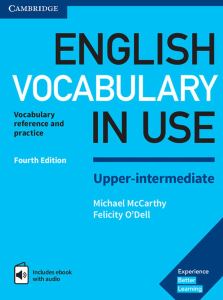
The “English Vocabulary in Use” series by Cambridge is an excellent choice for learners at various levels seeking to improve their vocabulary. This series is well-structured, with each book offering a range of vocabulary topics and practical exercises tailored to different proficiency levels. Whether for self-study or classroom instruction, these books provide clear explanations and engaging activities to help learners expand their vocabulary and use it confidently in context. Click here to learn more about the series and find the book that’s right for you.

BBC 6 Minute English offers a series of engaging podcasts designed to help learners improve their English listening skills. Each episode is only six minutes long, covering a wide range of interesting topics from everyday conversations to global issues. Along with the audio lessons, they provide exercises and practice materials that reinforce vocabulary and grammar, making it a great resource for learners at different levels looking to improve both their comprehension and fluency. Visit 6 Minute English’s official website.
Watch a few of my videos to see how I approach teaching and what you can expect.
Ready to Start Your English IELTS TOEFL SAT Journey?
TAKE IT TO THE NEXT LEVEL.