All You Need to Know About DET (Duolingo Exam)

Table of Contents
What Is Duolingo English Test (DET)?
The Duolingo English Test (DET) is an online English proficiency exam designed to measure a test taker’s abilities in reading, writing, speaking, and listening. The test is completed entirely online and typically takes about 45 minutes to one hour. It consists of a variety of question types, including multiple-choice questions, written responses, spoken responses, and interactive exercises that evaluate comprehension and communication skills. The DET includes a series of timed tasks, such as reading sentences and selecting missing words, listening to spoken English and identifying content, typing responses to prompts, and speaking answers into a microphone. The test also incorporates a video interview and writing sample that are sent to institutions alongside the score, allowing admissions staff to evaluate performance more qualitatively.
The exam uses an adaptive algorithm to adjust question difficulty based on the test taker’s responses, which aims to estimate proficiency efficiently. Scores range from 10 to 160, with subscores in literacy, conversation, comprehension, and production. The DET provides official score reports that are digitally verifiable and can be sent directly to participating institutions. Results are typically available within 48 hours. The DET is accepted by thousands of universities worldwide, including institutions in the United States, South Korea, the United Kingdom, Thailand, Japan, and Malaysia. Notable examples include Stanford University, Massachusetts Institute of Technology (MIT), Harvard University, Princeton University, California Institute of Technology (Caltech), Imperial College London, University of California, Berkeley, Yale University, The University of Chicago, and Johns Hopkins University. The test is accessible on computers with a camera, microphone, and reliable internet connection, and it can be taken from home without the need for a testing center.

The Test Environment
The Duolingo English Test must be taken in a quiet, well-lit room where you won’t be interrupted. You need a computer with a working camera, microphone, and speakers, and you cannot use any other devices or reference materials during the test. Phones, books, and notes are not allowed.
Before starting the test, you will need to verify your identity with a government-issued photo ID and ensure your face is visible on camera. The test is monitored by automated proctoring software, which checks for unusual movements, background noise, or attempts to use other programs. Any violations of these rules can result in your test being invalidated.
Each section of the test has its own time limits, and the system will automatically move forward or end the section if the time runs out. These rules are in place to make sure every candidate takes the test under the same conditions and that the results fairly reflect each person’s English proficiency.

Not Good Enough
This is just my personal take. If your main goal is simply to prepare for the test, feel free to skip this section.
I have serious reservations about the Duolingo English Test (DET) regarding quality control and professionalism. Some questions have multiple correct answers, and many interactions feel algorithmically generated rather than thoughtfully designed by language experts. While, unfortunately, many colleges and universities accept DET scores, I would not recommend it to students aiming to truly test their English skills. For those who just want the fastest route to admission, the DET can work, but it is a shortcut rather than a serious assessment.
Many DET question types feel more like games than real exams. For example, in the Read and Select questions, you have to decide whether a word is real English in just a few seconds. Image-based questions can also be inconsistent: some show groups of people engaged in activities, which gives a good chance to describe them, while others are random stock photos, like a rock wall or a tree, with little meaningful context. These exercises can be fun in classrooms or as games, but they do not reliably measure real-world English ability.
I also have strong opinions about adaptive tests in general, including the SAT. Adaptive testing punishes strong students by making questions harder as they answer correctly and rewards weaker students with laughably easy questions that inflate their scores. Instead of separating capable students from weaker ones, it pushes everyone toward a mediocre middle. This system encourages mediocrity under the guise of fairness, discourages real skill, and distorts the assessment of ability. As with everything “progressive”, it is theatrical empathy designed to make things worse on purpose.
Put briefly, if you decide to take the DET, you have to accept that you are choosing the easy route. It can get into universities faster without posing a real challenge, which should be the whole purpose behind higher education.
Test Structure
Getting Started
When you start the test, you’ll go through an introduction and setup that takes about 5 minutes. You’ll check that your computer’s camera, microphone, and speakers are working, set up your phone camera to record your computer, submit your government-issued photo ID, and review the test rules.
Adaptive Test
The main part of the test lasts around 45 minutes and adapts to your skill level. You’ll answer a variety of question types, and some questions will become easier or harder depending on how you perform.
Writing and Speaking Samples
At the end, you’ll complete a Writing Sample and a Speaking Sample, taking about 10 minutes total. The Speaking Sample lasts 1-3 minutes, while the Writing Sample lasts 3-5 minutes. You can review your responses after the test, and institutions that receive your scores will also see these samples.
Duolingo Test Scores
Understanding Your Scores
The Duolingo English Test reports both individual subscores and integrated subscores. Individual subscores show how you performed in reading, writing, listening, and speaking. Integrated subscores combine two related skills to show how well you can use them together. This gives a more complete picture of your English ability than just looking at the four skills separately.
How Subscores Are Calculated
Each individual subscore is based on your answers to specific test items. Your overall score is the average of the individual subscores, rounded to the nearest 5. Integrated subscores are calculated by averaging the two individual subscores that make them up. For example, a reading-writing integrated subscore reflects your ability to read and write in English together, while a listening-speaking integrated subscore reflects how well you can understand and speak English in combination.
Score Validity and Retakes
Your DET score is valid for two years. If you want to retake the test, you can buy another attempt, but you are limited to three tests within any 30-day period. You can use this information to plan your preparation and decide if and when you need to retake the test to improve your results.
Question Types
Read and Select
Directions: In this question type, you will see individual words and must decide whether each one is a real English word. When the timer starts, instructions will appear on the screen. Your task is to read each word carefully and select YES if it is a real word or NO if it is not.
Subscores: Reading, Literacy, Comprehension
Time: 5 seconds per word
Tips for Interacting with the Question:
• Click YES or NO for each word.
• After you answer, the next word will appear automatically.
• Make sure every word is answered. Skipped items are counted as incorrect.
• There may be any number of real words, so do not assume a pattern.
Tips for Responding:
• Read each word carefully. Some words may look like real English words but have small differences, such as missing letters or extra letters.
• Focus on whether the word is actually used in English, not just whether it looks familiar.
Example Words:
• Apple – YES, this is a real word. It is a fruit.
• Frend – NO, this is not correct. The correct spelling is “friend”.
• Glorpazorp – NO, not a real English word.
• Computer – YES, a real word referring to an electronic device for processing data.
• Runing – NO, the correct spelling is “running”.
Fill in the Blanks
Directions: In this question type, you will see a sentence with one incomplete word. Your task is to type the missing letters to complete the word correctly. Instructions will appear on the screen when the timer starts. Each item usually takes about 20 seconds.
Subscores: Reading, Literacy, Comprehension
Time: 20 seconds
Tips for Interacting with the Question:
• Use the backspace or delete button to remove letters if you make a mistake.
• Make sure to complete the word before moving on to the next sentence.
Tips for Responding:
• Read the entire sentence first to understand the meaning.
• Use context clues from surrounding words to help figure out the missing letters.
• Check that your completed word fits grammatically in the sentence.
Example Sentences:
“I am g____ to the park today.”
Completed: “I am going to the park today.”
“She likes to dr___ coffee in the morning.”
Completed: “She likes to drink coffee in the morning.”
“The child is pla____ with the toy.”
Completed: “The child is playing with the toy.”
Read and Complete
Directions: In this question type, you will see a passage with some words partially missing at the start. Your task is to type the missing letters to complete each word correctly. Instructions will appear on the screen when the timer begins. The full section usually takes about 3 minutes.
Subscores: Reading, Literacy, Comprehension
Time: 3 minutes for the whole section
Tips for Interacting with the Question:
• Use the backspace or delete button to remove letters if you make a mistake.
• Make sure each word is completed before moving on to the next one.
Tips for Responding:
• Read the whole passage first to understand the context.
• Use context clues from surrounding words to figure out each missing word.
• Pay attention to grammar and spelling to ensure your answers make sense in the sentence.
Example Passage:
Original passage with missing letters:
“Getting Lost in the City
I’m used to most subway systems. But t__ one i_ this ci__ always m____ me conf____ . I nev__ remember wh___ direction i_ north o_ south, east o_ west. I a_ always g_____ lost a__ ending u_ in str____ places. Good thing I like exploring new neighborhoods when I travel!”
Completed version:
“Getting Lost in the City
I’m used to most subway systems. But the one in this city always makes me confused. I never remember which direction is north or south, east or west. I am always getting lost and ending up in strange places. Good thing I like exploring new neighborhoods when I travel!”
Read Aloud
Directions: In this question type, you will see a written statement that you need to read aloud. Speak the statement clearly into your microphone. Instructions will appear when the timer begins. Each statement typically allows 20 seconds for recording.
Subscores: Speaking, Comprehension, Conversation
Time: 20 seconds per statement
Tips for Interacting with the Question:
• You only get one chance to record, so use your time wisely.
• Click RECORD NOW to start speaking, and click NEXT when finished. If you do not click NEXT, the test will automatically continue when the timer ends.
• Make sure your entire response is captured in the recording.
Tips for Responding:
• If possible, quickly practice reading the statement silently or out loud before recording.
• Pay attention to punctuation to help pace your reading; pause briefly at commas and periods.
• Speak clearly and at a natural pace. Enunciate each word so it can be understood easily.
Example Statement:
“The library closes at 6:00 PM on weekdays, but it is open later on weekends for students who need extra study time.”
Listen and Type
Directions: In this question type, you will hear a spoken statement and your task is to type exactly what you hear. Instructions will appear when the timer begins. This section typically lasts about 1 minute per statement.
Subscores: Listening, Comprehension, Conversation
Time: 1 minute per statement
Tips for Interacting with the Question:
• You can replay the statement up to two times (three plays total) by clicking the blue speaker icon.
• Pay close attention to punctuation and capitalization as you type.
• Make sure your typing is accurate and complete before moving on.
Tips for Responding:
• Type out what you hear first, even if you are unsure about some words.
• Replay the statement and compare it to your text to check for errors.
• Focus on spelling and word order to ensure your transcription matches the spoken statement.
Example Statement:
Audio: “The meeting has been rescheduled to Thursday afternoon at 3 PM in the main conference room.”
Interactive Reading: Complete the Sentences
Directions: In this question type, you will see a passage with several blank spaces. Your task is to select the best word from a set of options to complete each blank. This section usually takes 7-8 minutes for all six questions.
Subscores: Reading, Literacy, Comprehension
Tips for Interacting with the Question:
• You can complete the blanks in any order.
• You cannot move on until every blank has a selected response.
• Use your mouse, touchpad, or the tab key to navigate between blanks.
Tips for Responding:
• Read the entire sentence before choosing a word to make sure it fits contextually and grammatically.
• If time allows, review the full passage after answering all blanks to double-check your selections.
• Use logic and context clues rather than guessing randomly.
Example Passage 1:
Susan had long been dreaming of 1_____ a vacation, but she and her 2______ Michael kept postponing it. Finally, they decided on a weekend visit to Ocean City 3______ their two children.
Options:
1: becoming, taking, staying, saying, finding
2: grandmother, brothers, children, husband
3: after, with, in, as, on
Example Passage 2:
James wanted to improve his cooking skills, so he enrolled in a 1 class. He practiced every day and even invited his 2 to taste his new recipes. After several weeks, he was able to cook meals 3 his friends complimented.
Options:
1: painting, music, cooking, dancing
2: colleagues, neighbors, parents, pets
3: that, where, which, when
Correct answers: 1: cooking, 2: parents, 3: that
Interactive Reading: Complete the Passage
Directions: In this question type, you will see a passage with a missing sentence in the middle. Your task is to select the best sentence from a set of options to complete the passage. This section usually takes 7-8 minutes for all six questions.
Subscores: Reading, Literacy, Comprehension
Tips for Interacting with the Question:
• If you hover over each option, you can see it in context within the passage.
• Read all options carefully before making your choice.
Tips for Responding:
• Some parts of the passage may be familiar from the Complete the Sentences section. Read carefully, especially new material.
• Pay close attention to the sentences immediately before and after the blank—they often give clues about the correct answer.
• Focus on logical flow, grammar, and context to select the most natural sentence.
Example Passage:
Susan had long been dreaming of taking a vacation, but she and her husband Michael kept postponing it. Finally, they decided on a weekend visit to Ocean City with their two children.
[Blank]
Ocean City did not disappoint them. The weather was sunny and warm, and all four family members spent a great deal of time on the beach. When Monday morning came and they began the drive back home, they all felt very glad they’d made this enjoyable trip.
Options:
1. Susan’s aunt did everything she could think of to make sure the family was happy.
2. This picture of Susan and her family would be one of his most prized possessions.
3. The kids were very excited to be going on a family vacation, and so was Susan.
4. They all enjoyed the meal very much and then went to see a movie.
Correct answer: 3. The kids were very excited to be going on a family vacation, and so was Susan.
Interactive Reading: Highlight the Answer
Directions: In this question type, you will see a passage and a question about it. Your task is to click and drag to highlight the text in the passage that answers the question. This section usually takes 7-8 minutes for all six questions.
Subscores: Reading, Literacy, Comprehension
Tips for Interacting with the Question:
• Once you highlight the text, it will appear in the box below so you can see it in context.
• If you need to adjust your selection, click and drag again to highlight the correct portion.
• Make sure the highlighted text matches the answer you intend to submit before clicking Next.
Tips for Responding:
• Be precise but thorough: highlight only the portion of the passage that directly answers the question.
• Avoid highlighting extra sentences or irrelevant text.
• Use context clues from the passage to ensure your selection is accurate and complete.
Example Passage:
Susan had long been dreaming of taking a vacation, but she and her husband Michael kept postponing it. Finally, they decided on a weekend visit to Ocean City with their two children. The kids were very excited to be going on a family vacation, and so was Susan. Ocean City did not disappoint them. The weather was sunny and warm, and all four family members spent a great deal of time on the beach. When Monday morning came and they began the drive back home, they all felt very glad they’d made this enjoyable trip.
Question: What was the weather like when they arrived?
Answer (the part that you should highlight): “The weather was sunny and warm”
Interactive Reading: Identify the Idea
Directions: In this question type, you will read a passage and then select the idea that best represents what the passage expresses. This section usually takes 7-8 minutes for all six questions.
Subscores: Reading, Literacy, Comprehension
Tips for Interacting with the Question:
• Once you select your response, the box around it and the circle next to it will turn blue.
• You can change your selection if you reconsider before submitting.
Tips for Responding:
• Read all options carefully. Some may seem somewhat related, but only one best summarizes the main idea of the passage.
• Focus on the overall theme or purpose of the passage rather than small details.
• Avoid options that are too narrow or that only describe one part of the passage.
Example Passage:
Biophysics is the study of the physical properties of living things. This field refers to physics, which is the science of matter and energy, and also to biology, the science of living things. Biophysicists study the physical properties of organisms and the effects of physical processes on living things. For example, biophysicists might study the effect certain chemicals have on living cells, determine how tiny structures within cells work, or explain how injuries and diseases affect the structure of skin. Some biophysicists also study the interaction of radiation with biological systems. Biophysics is an interdisciplinary field; it is not limited to physics or biology. Biophysicists might also work on projects involving chemistry, geology, and other fields.
Question: Which idea best represents the passage?
Answer (correct choice): Biophysics studies the physical properties of living things and how they interact with biological systems.
Interactive Reading: Title the Passage
Directions: In this question type, you will read a passage and select the title that best represents the content. You will choose from a list of given options. This section usually takes 7-8 minutes for all six questions.
Subscores: Reading, Literacy, Comprehension
Tips for Interacting with the Question:
• Once you select your response, the box around it and the circle next to it will turn blue.
• You can change your selection if you reconsider before submitting.
Tips for Responding:
• Read all title options carefully. Some may be somewhat related, but only one is the best representation of the passage.
• Focus on the overall topic and purpose rather than small details.
• Avoid choosing titles that are too narrow, too broad, or unrelated to the main content.
Example Passage:
Biophysics is the study of the physical properties of living things. This field refers to physics, which is the science of matter and energy, and also to biology, the science of living things. Biophysicists study the physical properties of organisms and the effects of physical processes on living things. For example, biophysicists might study the effect certain chemicals have on living cells, determine how tiny structures within cells work, or explain how injuries and diseases affect the structure of skin. Some biophysicists also study the interaction of radiation with biological systems. Biophysics is an interdisciplinary field; it is not limited to physics or biology. Biophysicists might also work on projects involving chemistry, geology, and other fields.
Question: Which title best represents the passage?
Options:
1. The Nature of Motion
2. An Introduction to Biophysics
3. Computer Simulations and Living Systems
4. Understanding Physical Science in Biology
Answer (correct choice): An Introduction to Biophysics
Listen and Respond
Directions: In this question type, you will hear a conversation in short segments. Your task is to select the best response each time it is your turn. This section typically takes about 4 minutes and includes several questions (usually around 5).
Subscores: Listening, Comprehension, Conversation
Tips for Interacting with the Question:
• Each audio clip can only be played once.
• You can read previous parts of the conversation on screen to help you understand the context.
• Pay attention to the relationship between the speakers, such as two students talking or a teacher and a student.
Tips for Responding:
• Choose the response that best continues the conversation.
• If your first choice isn’t perfect, you can still answer the following parts correctly.
• Focus on the content and meaning of the conversation to make accurate choices.
• Remember the main points of the conversation for later tasks, such as summaries.
Tutor’s Notes:
Get ready for questions having multiple correct answers and don’t try to make sense of them!
Summarize the Conversation
Directions: In this question type, you will summarize the conversation you just heard. You have 75 seconds to complete your summary.
Subscores: Listening, Writing, Literacy, Comprehension, Conversation, Production
Tips for Responding:
• Don’t worry if you didn’t choose the best responses in the previous Listen and Respond section. Focus on summarizing the conversation.
• Write a complete paragraph instead of separate bullet points.
• Start with the key facts: who was speaking, what the conversation was about, and what was decided or concluded.
• Include as much detail as you can within the time limit.
• Use all of the 75 seconds—if possible, review your spelling and grammar before submitting.
Example Summary:
In the conversation, two students discussed the reading assignment for their biology class. One student had finished the reading and offered to help the other understand a difficult section. They went over the main points together, and the student who needed help felt more confident about the material by the end of the discussion.
Fun fact:
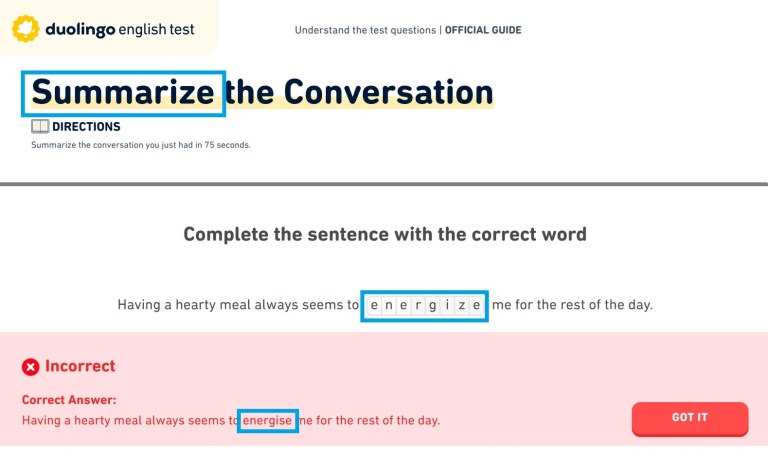
Duolingo’s official documents use the American spelling “summarize,” not the British “summarise.” Yet in a lesson yesterday, when I answered a fill-in-the-blank question with “energize,” the test marked it wrong. The correct answer? “Energise.” Apparently, Duolingo can arbitrarily decide whether it wants the American or British spelling. “Got it!”
Write About the Photo
Directions: In this question type, you will see an image on the screen and write a description of it for 1 minute. Instructions appear when the timer begins.
Subscores: Reading, Listening, Speaking, Writing, Literacy, Comprehension, Conversation, Production
Tips for Interacting with the Question:
• You can view the image while writing your response.
• Use your mouse or trackpad to scroll back and review your writing for spelling and grammar.
Tips for Responding:
• Go beyond simply naming objects. Describe details such as actions, relationships, colors, and locations.
• Although the instructions ask for one complete sentence, writing multiple sentences helps show more of your English skills.
• Focus on clarity, accuracy, and organization. Use appropriate vocabulary and sentence structure to describe the image.
Example:
In the image, a young woman is sitting at a desk with a laptop open in front of her. She appears to be studying, as she has a notebook and pen in hand. Behind her, a large window lets in natural light, and there are books stacked on a nearby shelf. The room is tidy and organized, suggesting a calm and focused atmosphere.
Tutor’s Notes:
I recommend using stock photo websites like Shutterstock or Freepik to practice this task, as many DET sample questions feature similar images. Freepik, in particular, has examples very similar to those used on the test.
Interactive Writing
Directions: In this question type, you will write about a topic in two steps. First, respond to a written prompt for 5 minutes. Then, you will respond to a follow-up prompt for 3 minutes. Instructions for the second step appear when the timer begins.
Subscores: Writing, Literacy, Production
Tips for Interacting with the Question:
• You can see the current step’s prompt while writing.
• During step 2, you can review your initial response to help develop your follow-up.
• Proofread carefully. Do not click NEXT until you have checked your response for the current step and are ready to submit.
Tips for Responding:
• Use all of the time available to write clear, complete responses.
• Write as much as you can while staying relevant and using English effectively.
• Apply good writing practices: organize your ideas, use paragraphs, vary your sentence structures, and check spelling and grammar.
• Focus on demonstrating your ability to communicate ideas clearly and coherently in writing.
Duration:
Step 1: 5 minutes
Step 2: 3 minutes
Example:
Step 1 Prompt: Describe a memorable trip you took and explain why it was meaningful.
Step 2 Prompt: How did this trip change your perspective or plans for the future?
Listen, Then Speak
Directions: In this question type, you will listen to a prompt and then speak your response for up to 90 seconds. The directions appear for 20 seconds before recording begins. During this time, you can hear and replay the prompt.
Subscores: Speaking, Conversation, Production
Tips for Interacting with the Question:
• You must speak for at least 30 seconds. After 30 seconds, the NEXT button will turn blue, allowing you to naturally finish your response and submit.
• Replay the prompt up to two times (three plays total) to make sure you understand it fully before starting.
Tips for Responding:
• Speak naturally and clearly, using varied vocabulary and sentence structures.
• Focus on addressing the prompt directly and organizing your ideas logically.
• Include examples or details to support your points.
• Use the full time wisely to give a complete and coherent response.
Duration: Minimum 30 seconds, Maximum 1 minute 30 seconds
Example Prompt: Describe a hobby or activity you enjoy and explain why it is important to you.
Sample Response: I enjoy hiking because it allows me to relax and get exercise at the same time. When I hike, I can disconnect from my phone and focus on nature. It also gives me a chance to spend time with friends or family outdoors. Hiking has helped me stay healthy and manage stress, which makes it an important part of my weekly routine.
Speak About the Photo
Directions: In this question type, you will speak about an image that appears on the screen for up to 90 seconds. The directions and image will appear for 20 seconds before automatically advancing to the recording screen. You can also click NEXT to advance manually. You must speak for at least 30 seconds before moving on.
Subscores: Speaking, Conversation, Production
Tips for Interacting with the Question:
• You have 20 seconds to look at the photo before recording begins. Use this time to carefully observe the image and plan your response.
• You can view the image while you speak.
• You have only one opportunity to record your answer, so prepare mentally before starting.
Tips for Responding:
• Describe the image as if explaining it to someone who cannot see it.
• Speak clearly at a natural pace and enunciate words carefully.
• Include details such as people, objects, actions, locations, and relationships.
• If you stumble on a word or phrase, keep going—don’t stop or panic.
• Similar to the Write About the Photo task, I recommend practicing with stock photo websites like Shutterstock or Freepik to become familiar with the types of images used in the test.
Duration: Minimum 30 seconds, Maximum 1 minute 30 seconds
Example Response:
In the image, a man is standing on a busy city street, holding an umbrella while waiting for a bus. Cars are lined up along the road, and people are walking on the sidewalk in both directions. The sky is cloudy, suggesting that it might rain. The man appears to be looking at his watch, indicating he is checking the time. Overall, the scene captures the hustle and bustle of city life during a rainy day.
Read, Then Speak
Directions: In this question type, you will see a written prompt and speak your response for up to 90 seconds. The directions appear for 20 seconds before the timer begins. You must speak for at least 30 seconds before moving on.
Subscores: Speaking, Conversation, Production
Tips for Interacting with the Question:
• Take your time to read the question carefully and plan your response before the recording starts.
• You can still view the prompt while speaking your answer.
Tips for Responding:
• Speak naturally and clearly, using varied vocabulary and sentence structures.
• Make sure you answer all of the questions in the prompt.
• Include specific details and examples to make your answer complete and engaging.
Duration: Minimum 30 seconds, Maximum 1 minute 30 seconds
Sample Question:
Talk about your favorite restaurant.
• Where is it?
• What type of food does it serve?
• How often do you go there?
• Why is it your favorite?
Writing Sample
Directions: In this question type, you will write about a topic for up to 5 minutes. The directions appear for 30 seconds before the 5-minute timer begins. During this time, read and consider the prompt and prepare your response. You must write for at least 3 minutes.
Subscores: Writing, Literacy, Production
Tips for Responding:
• Practice good writing habits: vary sentence structures and word choice, and organize your ideas with logical transitions.
• Leave time to check spelling, grammar, and punctuation.
• Make sure your response is relevant to the topic, as it will be shared with institutions that receive your results.
• Treat this as a short essay. The Writing Sample demonstrates your ability to communicate effectively in writing and provides additional insight into your skills.
Duration: Minimum 3 minutes, Maximum 5 minutes
Sample Question:
Think about a time when you stopped to look at something beautiful (like a sunset or a flower). Describe the experience. Include specific details.
Sample Response:
Last summer, I was walking along a quiet beach at sunset. The sky was painted with shades of orange, pink, and purple. I paused to watch the waves gently lap the shore and felt the cool breeze on my face. The sound of seagulls and the rhythm of the water made me feel calm and peaceful. I noticed the reflection of the sun on the wet sand and took a moment to simply enjoy the beauty around me. It was a quiet, memorable moment that reminded me to appreciate small, natural wonders in everyday life.
Speaking Sample
Directions: In this question type, you will read a written prompt and speak about it for up to 3 minutes. The directions appear for 30 seconds before recording begins. During this time, read and consider the prompt and prepare your response. You must speak for at least 1 minute.
Subscores: Speaking Conversation, Production
Tips for Interacting with the Question:
• Do not watch the timer, as it can distract you from thinking and speaking clearly.
• Keep talking until the NEXT button turns blue, and continue if you can. Conclude naturally before clicking NEXT to submit.
• Practice speaking about topics in English for 1–3 minutes before the test to become comfortable with the timing.
• Remember, the Speaking Sample is recorded as a video, so recipients of your results will see and hear you.
• Make sure your response is relevant and demonstrates your speaking skills clearly.
Duration: Minimum 1 minute, Maximum 3 minutes
Sample Question:
Think of a time when learning something in the classroom or at work helped you understand a situation more clearly. How did this insight shape your perspective?
Sample Response:
In my first job as a customer service assistant, I learned about conflict resolution techniques during a training session. One day, a customer was very upset about a delayed shipment. Using the skills I had just learned, I listened carefully, acknowledged their frustration, and calmly explained the steps I would take to resolve the issue. This approach helped the customer feel heard and satisfied with the solution. That experience taught me the importance of active listening and clear communication, and I now approach conflicts with patience and understanding.
Watch a few of my videos to see how I approach teaching and what you can expect.
Ready to Start Your English IELTS TOEFL SAT Journey?
TAKE IT TO THE NEXT LEVEL.